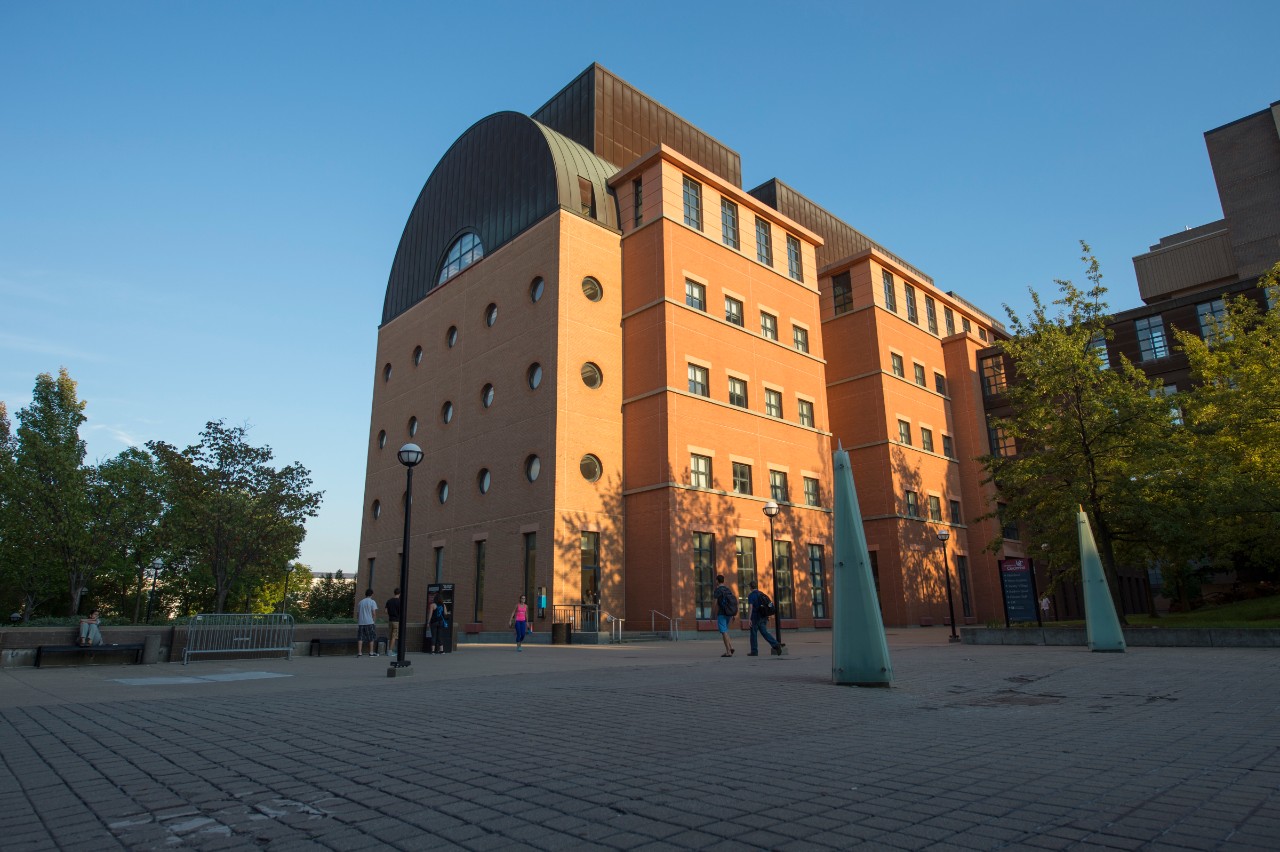
UC professor presents non-destructive evaluation process research to grad students


UC professor of aerospace engineering and engineering mechanics Francesco Simonetti Ph.D.
Additive manufacturing and 3D-printing have emerged over the past decade as manufacturing processes. With their emergence have come a new set of challenges for the engineering world to address. One of those challenges is evaluating complex-shaped components in a way that is not destructive.
University of Cincinnati professor of aerospace engineering and engineering mechanics Francesco Simonetti, Ph.D. is working toward a possible solution and recently presented his work in a seminar to current UC engineering graduate students.
In the presentation, Simonetti used the example of a complex manufactured component like a rotor or gear that might be suspected be damaged internally, in areas you cannot see on the surface. If such a component is to be used in safety-critical applications, it is essential that it is free from damage to avoid failure during operation which could result in substantial economic costs or even the loss of human lives.
Simonetti’s solution borrows from methods already used in medical imaging, geophysics, and the fossil fuel industry – mechanical wave sensing.
Waves can be used to see inside the human body or the Earth because both of those structures do not have extreme variation in the speed in which sound passes through them. This luxury is not immediately possible in a mechanical part that is made of aluminum, but that has complex gaps internally.
To address this, Simonetti submerges the component in water and freezes it, creating a cylinder of ice and the aluminum component. Sound travels through aluminum and ice at different speeds but speeds that are close enough to make the sonogram readable, eliminating many of the distorted visual artifacts created when the difference is too great.
It gets much more complicated that just freezing water with the component submerged. The water must degassed in a vacuum and then frozen in a single direction to avoid any cracking. There are additional steps in agitating the water while it freezes, smoothing the ice, and forming a useful connection with the scanner by using spring loading and heat transfer fluid.
At the end of the presentation, graduate students asked questions about wavelengths used and freezing other liquids other than water. This learning process is beneficial to both presenter and students as questions are answered or other possibilities are discussed.
Related Stories
From uncertainty to innovation
September 17, 2026
Fall campaign story 2026 - College of Engineering and Applied Science.
Aerospace engineering alumnus honored with Kautz Master Alumni Award
September 14, 2026
University of Cincinnati alumnus Dinesh Keskar spent nearly four decades at the Boeing Company and facilitated billions of dollars in sales. HE earned his M.S. and PhD from the College of Engineering and Applied Science. Earlier this year, he was honored by UC with the prestigious Kautz Alumni Master Award.
UC student ties his own world record in competitive speedcubing
September 10, 2026

Speedcuber's Digest highlighted University of Cincinnati computer science student's two-time 2x2 speedcubing world recor.d At a recent competition in Mississippi, Sujan Feist recorded a 0.86 second average, tying the previous world record, which he set.