Spectrum News: UC develops new medical apps
Engineering professor Andrew Steckl is developing new applications for the fabrication process

University of Cincinnati engineering professor Andrew Steckl spoke to Spectrum News 1 about promising medical innovations he is developing using century-old technology.
Steckl, a professor of electrical engineering in UC's College of Engineering and Applied Science, is working on new treatments for brain tumors and cancer using a fabrication process called coaxial electrospinning. It combines two or more materials into a fine fiber for use in industry, textiles or even medicine.

Coaxial electrospinning creates a spiderweb-thin fiber. UC is using unique combinations of polymers to develop new medical treatments. Photo/Joseph Fuqua II/UC Creative Services
In the clean room of his Nanoelectronics Laboratory, Steckl creates spiderweb-thin fibers with a core of one material surrounded by a sheath of another. Through unique combinations, he can take advantage of the properties of one material with the powerful benefits of another.
“It’s a bit of complicated physics,” Steckl told Spectrum 1 News. “When you combine the forces of an electric field with the viscous forces of a fluid, you create a very fine jet. It’s stable for a bit and then it becomes unstable and begins to spin around – hence, electrospinning.”
Electrospinning was invented in 1902 for use in textiles. But Steckl has been applying it to medical applications for new drug-delivery systems and novel treatments for a brain tumor called glioblastoma.
Steckl said electrospun pharmaceuticals could release fast-acting painkillers through the outer fiber layer while the inner layer would provide a longer-lasting or slow-release therapeutic drug.
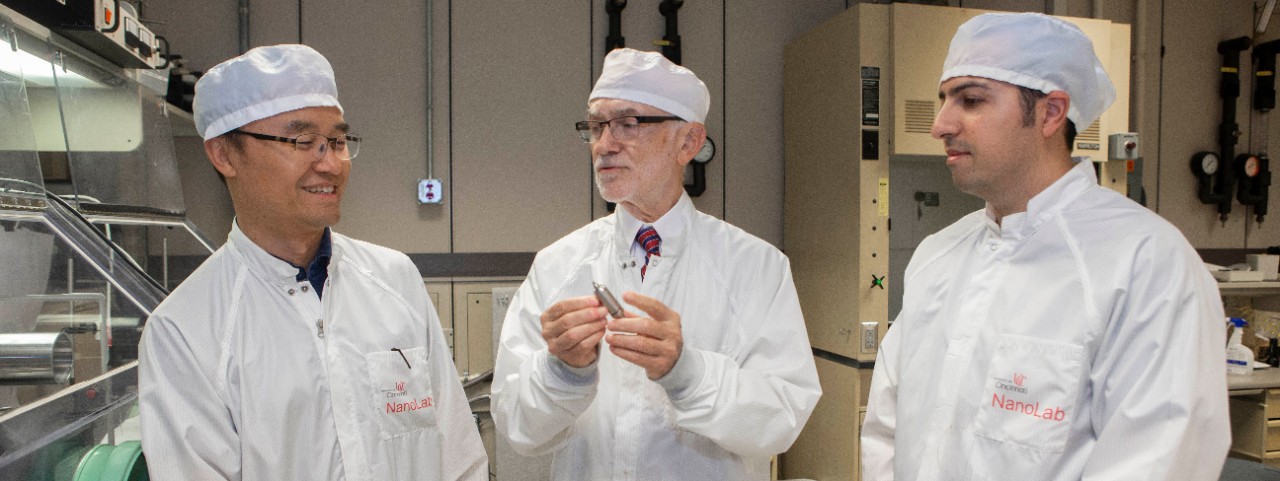
Featured image at top: University of Cincinnati professor Andrew Steckl, center, talks with UC senior research associate Daewoo Han, left, and Turkish researcher Serdar Tort in Steckl's Nanoelectronics Laboratory. Photo/Joseph Fuqua II/UC Creative Services

University of Cincinnati professor Andrew Steckl is developing innovative medical applications using coaxial electrospinning in his Nanoelectronics Laboratory. Photo/Rod Hissong/Spectrum News 1
More news coverage of UC's research
- Science Daily: Electrospun fibers weave new medical innovations
- The Verdict: The 100-year-old manufacturing technique set to revolutionize medicine
- SciTechDaily: Not Spiderwebs: These Electrospun Fibers Weave New Medical Innovations
- MedGadget: Coaxial Electrospinning Creates Novel Contraceptive, Other Devices
Become a Bearcat
- Apply online or get more information about undergraduate enrollment by calling 513-556-1100.
- Learn more about UC's many undergraduate and graduate programs.
Related Stories
UC part of $18 million initiative to expand behavioral health workforce in Ohio
September 23, 2026

The University of Cincinnati is participating in a new $18 million statewide scholarship program, as Cleveland.com recently reported, to address critical shortages of mental health and substance use treatment providers across Ohio.
Cincinnati entrepreneurs on the rise, with UC’s help
September 23, 2026
Eight startup companies recently graduated from the University of Cincinnati’s Venture Lab, showcasing newfound business skills and publicly proving their readiness to scale.
Payload receives big payday with $9M milestone
September 22, 2026

1819 Innovation Hub-based payments platform Payload received $9 million in series A funding from Fifth Third Bank, offering the company’s first large-scale investment from another Cincinnati-based firm.