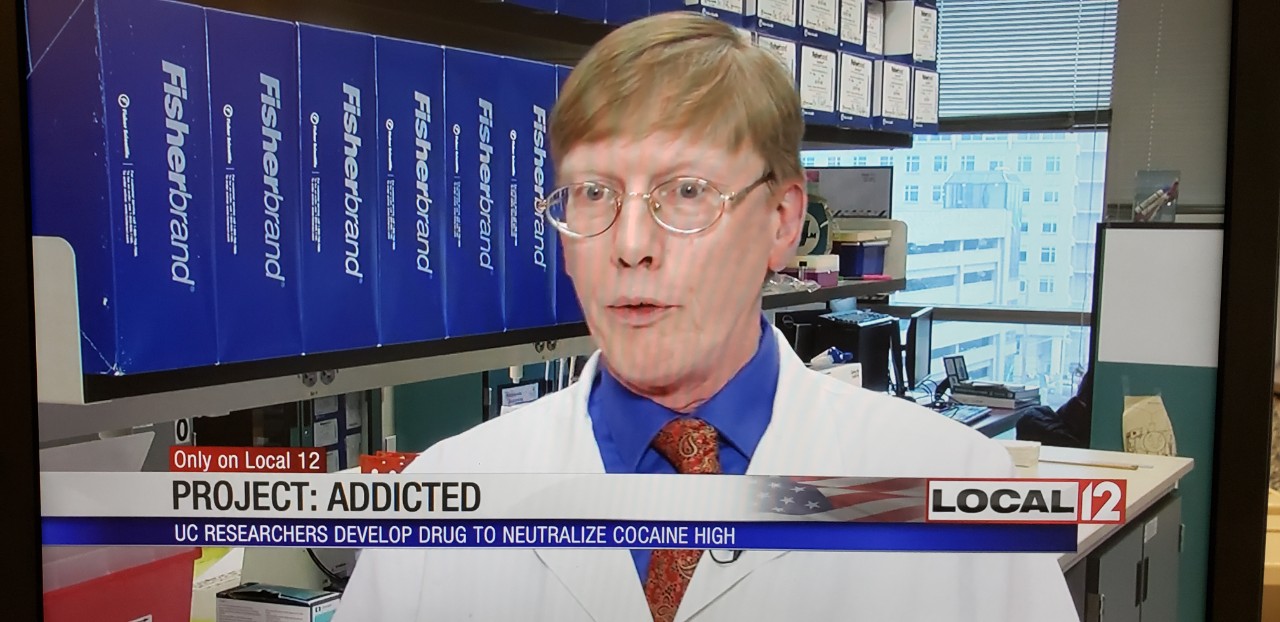
WKRC-Local News 12: UC researchers develop antibody to neutralize cocaine high
UC scientist makes advances in treating addiction

Local 12 News journalist Angenette Levy spoke with Andrew Norman, professor in the UC Department of Pharmacy and Systems Physiology, for a segment about his latest research. Norman leads a team of researchers at UC College of Medicine, who have developed an anti-cocaine antibody for humans that may help block the effects of cocaine and aid individuals battling drug addiction to stay in recovery.
The human antibody, reengineered in a laboratory, is now being manufactured for human trials that are expected to begin later this year. When injected into the bloodstream, that antibody attaches to cocaine, preventing it from entering the brain and limiting its behavioral effects. Its success at reducing the drug’s effects have been documented in animal models of cocaine relapse.
Norman said the antibody isn’t a silver bullet, but possibly another tool in the toolbox for battling addiction. He spoke to Levy along with collaborator Terry Kirley, also a professor in the UC Department of Pharmacy and Systems Physiology.
Listen to the full segment on WKRC-Local 12 News.
Related Stories
President Pinto’s 2nd glow party brings first-year Bearcats together
September 20, 2026
UC President Neville Pinto and team hosted the second annual Bright Beginnings glow party for first-year students
This September, give blood for local patients fighting cancer and sickle cell disease
September 18, 2026
September is dedicated to raising awareness of several serious diseases, including sickle cell disease and childhood cancer. For patients in Greater Cincinnati fighting these diseases, awareness is only part of the equation. They also need lifesaving blood products.
UC emergency medicine physicians safely eliminate thousands of unnecessary CT scans
September 18, 2026
A University of Cincinnati emergency medicine quality improvement campaign avoids 3,500-plus head and cervical spine CT scans, saving $6.2 million in patient charges, more than 14,000 hours of waiting time and significant radiation exposure with no patient harm.