Bioengineer: UC builds better color vision test for animals
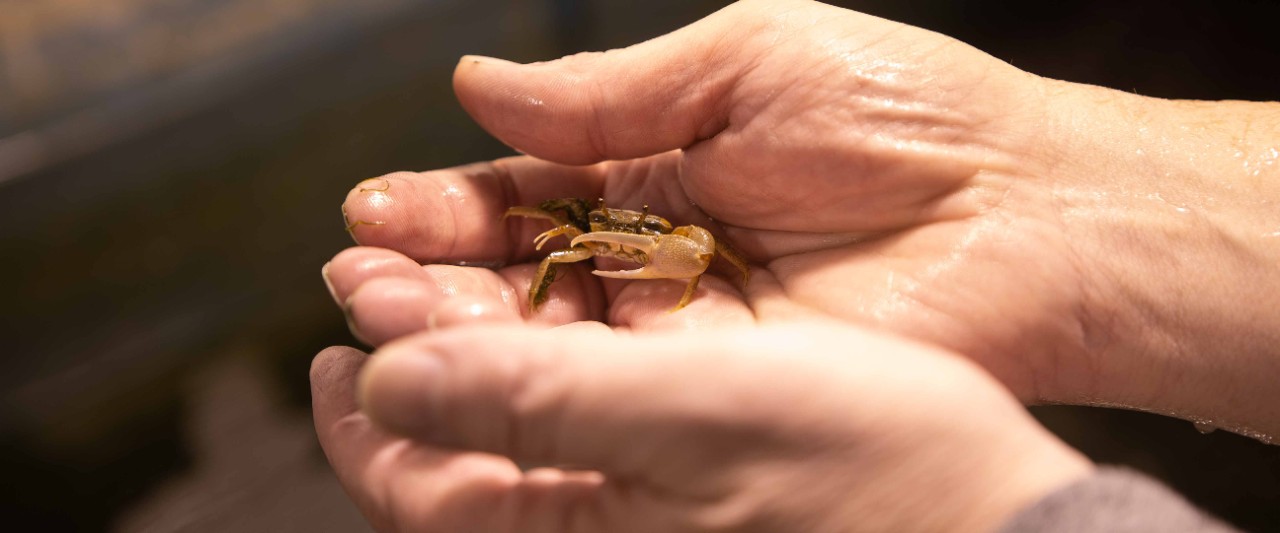
UC biologist John Layne is studying fiddler crabs and other animals in his lab

Bioengineer.org highlighted research by University of Cincinnati biologists who are studying the color vision of animals.
John Layne, an associate professor in UC's College of Arts & Sciences, modified simple electronics to develop a color vision test for fiddler crabs. A crab is placed in a little glass arena under a tilted screen projecting a video illuminated in color by blue or green light-emitting diodes.
A video shows a looming stimulus, a fast-approaching round ball. The crabs consistently skitter out of the way when they detect the optical illusion, which helps Layne and his students test the spectrum of visible light they can see.
"We're using it to test color discrimination. For an animal to have color vision, what that really means is the ability to discriminate different wavelengths of light," Layne said.
Featured image at top: UC biologists are studying the color vision of fiddler crabs. Photo/Andrew Higley/UC Creative + Brand

UC associate professor John Layne explains how his color vision test works. It uses a stripped-down liquid crystal display illuminated with adjustable light-emitting diodes. Photo/Andrew Higley/UC Creative + Brand
More UC biology news

A jumping spider. Photo/Joseph Fuqua II/UC Creative + Brand
Related Stories
UC, NKU renew longstanding partnership supporting Army ROTC cadets
August 26, 2026
The University of Cincinnati Army ROTC and Northern Kentucky University (NKU) have renewed a longstanding partnership that supports students preparing to become Army officers and leaders in their communities. The universities formalized the renewed agreement during a signing event Aug. 11 at NKU.
Roman law expert pieces together ancient legal history
August 25, 2026
UC Classics scholar Matthijs Wibier reconstructed and translated a 1,600-year-old Latin legal text from Egyptian parchment fragments at the Penn Museum, revealing previously unknown Roman tax laws.
Philanthropy allows University of Cincinnati law students to turn curiosity into confidence
August 25, 2026
Jordan Bleznick, A&S ’76, is creating opportunities for the next generation of tax attorneys through the Bleznick Tax Fellowship at the Donald P. Klekamp College of Law at the University of Cincinnati.