WVXU: 'Scary' movie proves crabs can see different colors
UC biologist John Layne talks about his novel vision test for fiddler crabs

Cincinnati Public Radio's WVXU spoke to University of Cincinnati biologist John Layne about the clever color vision test he designed for small animals such as fiddler crabs in his lab.

A fiddler crab. Photo/Andrew Higley/UC Creative + Brand
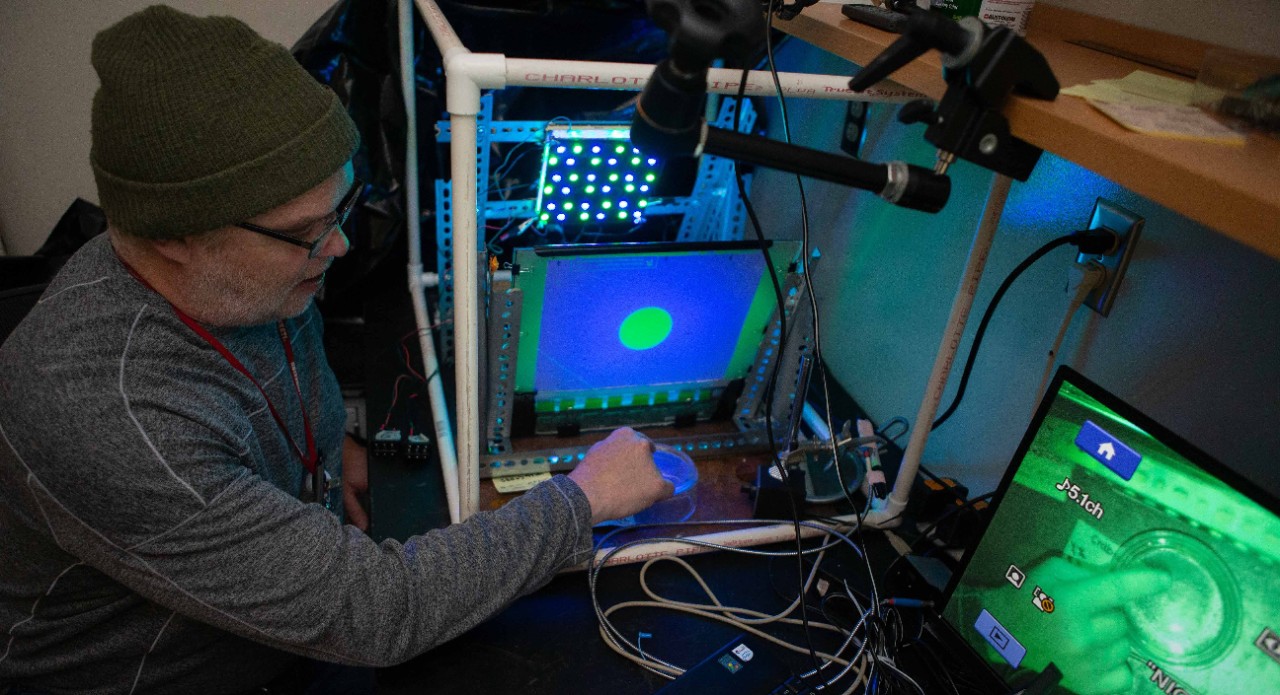
Layne, an associate professor in UC's College of Arts and Sciences, uses a stripped down LCD screen illuminated with an adjustable panel of green and blue light-emitting diodes. The LCD screen displays an image of a fast-approaching ball on a collision course with crabs placed in an arena in front of the screen. If the crabs can discern the two colors that make up the image, they react by running out of the way.
"The movie is very, very scary to a crab," Layne told WVXU. "Their reaction is not subtle. They will sprint really fast."
Layne shared his simple color-vision device with other researchers in an article published in the British Ecological Society journal Methods in Ecology and Evolution. Now he and his students are putting the crabs to the test to see what range of colors they can see.
Featured image at top: UC biologist John Layne explains how he uses an LCD screen and a bank of light-emitting diodes to create his optical illusion video of a fast-approaching object for crabs that are placed in a glass arena in front of the screen. Photo/Andrew Higley/UC Creative + Brand

UC biologist John Layne and his students are investigating the color vision of animals in his biology lab. Photo/Andrew Higley/UC Creative + Brand
More UC biology news

UC student Jenny Yi-Ting Sung holds a spider in a biology lab. Photo/Joseph Fuqua II/UC Creative + Brand
Related Stories
Parakeet males, females equally likely to fight
September 14, 2026
Researchers from the University of Cincinnati and Duke University studied captive monk parakeets and found that sex has little effect on who starts fights, who is targeted or who rises in the dominance hierarchy, as reported in Integrative & Comparative Biology.
UC part of $18 million statewide initiative to expand behavioral health workforce
September 14, 2026
The University of Cincinnati is part of Ohio’s $18 million Behavioral Health Scholarship Program, offering full in-state tuition to eligible social work, mental health counseling and clinical psychology graduate students who commit to serving underserved Ohio communities after graduation.
Could a whale really swallow a person whole?
September 10, 2026

Science News turns to a University of Cincinnati biologist to learn about animals that can swallow people whole as Hollywood gives moviegoers another reason to stay out of the water with the release next month of "Whalefall."