Reuters Health: RF ablation could be option for some thyroid cancers

Radiofrequency ablation (RFA), a minimally invasive treatment, could be a safe and effective treatment for low-risk thyroid cancers, according to a new study.
RFA is an alternative to surgery where a small needle elctrode is inserted into a nodule using ultrasound guidance. Heat generated at the needle tip can destroy target tissue, in this case low-risk papillary microcarcinomas of the thyroid.
Tammy Holm, MD, PhD, assistant professor of surgery in the University of Cincinnati College of Medicine's Department of Surgical Oncology and Department of Cancer Biology and a UC Health thyroid cancer surgeon and specialist, reviewed the recent study for Reuters Health and said RFA presents a great opportunity to scale down treatment from an operating room to an outpatient doctor's office visit with similar outcomes.
"RFA is potentially an incredibly valuable tool for the management of thyroid cancer and a skill that endocrine surgeons must develop in order to provide the best possible care for their patients with both benign and malignant disease," Holm said. "Large-scale prospective studies looking to establish the efficacy of RFA as an alternative or even adjunct to surgery will be valuable moving forward."
Read the Reuters Health article.
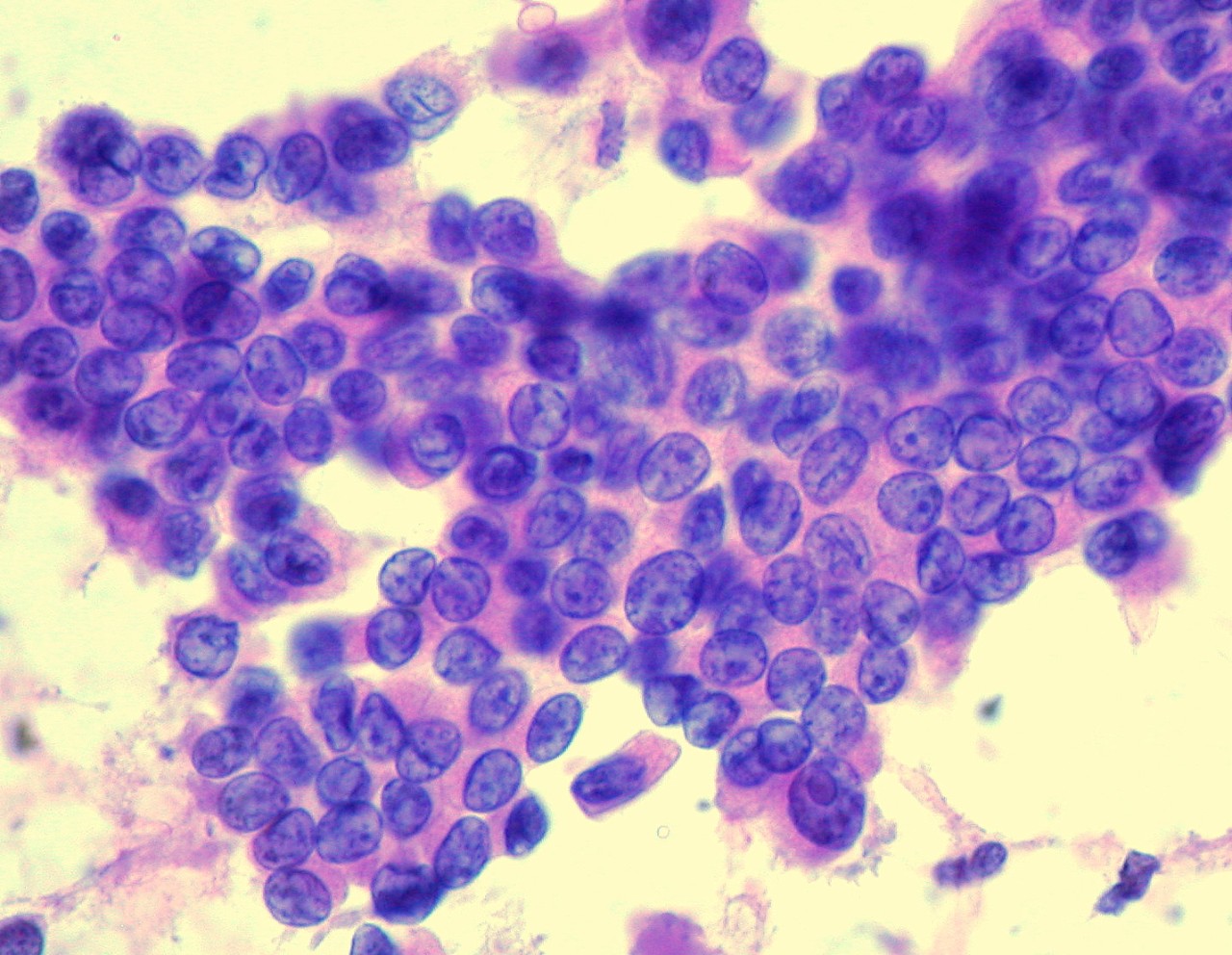
Featured photo at top of papillary carcinoma of the thyroid by Ed Uthman/Creative Commons.
Related Stories
These teeny spiders are social media stars
August 28, 2026

The New York Times turned to a University of Cincinnati professor to explain the appeal of jumping spiders on social media.
An internal divide among unions on AI impacts the Wisconsin gubernatorial race
August 28, 2026

Anne Lofaso, a professor in the Donald P. Klekamp College of Law at UC, spoke with Wisconsin Public Radio, about the schism among unions over AI and whether it is a plus, a negative, or somewhere in between when looking at job creation.
On-site training in Speech & Hearing Clinic sets UC’s programs apart
August 27, 2026
At the University of Cincinnati’s Speech & Hearing Clinic, Doctor of Audiology and Speech-Language Pathology graduate students gain real-world experience while providing free speech and hearing services to the community.