Yahoo! News: Electricity cap used to treat brain tumors

The University of Cincinnati is one of the trial sites for the TRIDENT clinical trial, testing the effectiveness of electrical field treatment for glioblastoma patients earlier in treatment regimens.
Kyle Wang, MD, a University of Cincinnati Cancer Center member and assistant professor of clinical radiation oncology in the UC College of Medicine, explained that human cells naturally use electricity to line up certain cellular structures, including materials called mitotic spindles, that are used for cell division and growth. To prevent tumor cells from growing, an alternating electric field can be focused at the tumor to disrupt this process.
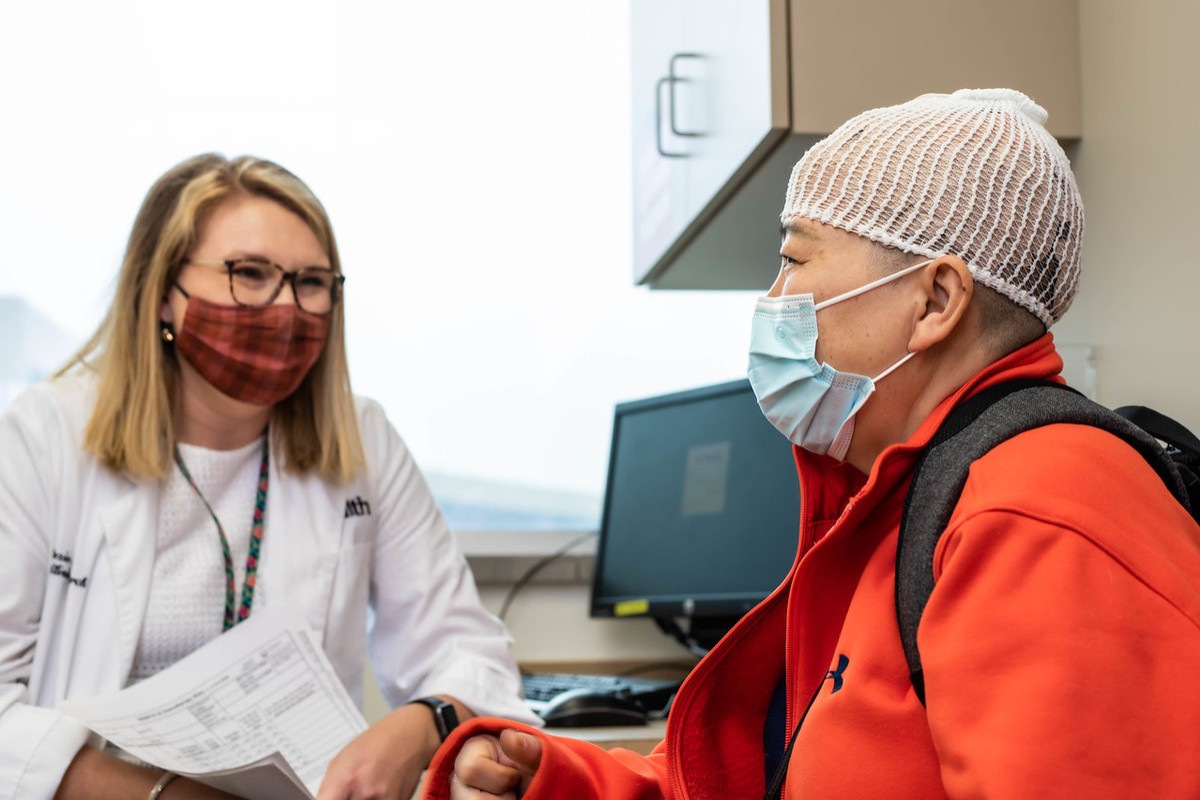
The treatment is delivered through a group of electrical arrays, a configuration of electrodes that looks like a mesh cap worn on the head, called an Optune device.
A number of local TV stations across the country, as well as Yahoo! News, have featured the research in recent segments.
Watch the Yahoo! News segment, originally aired on NewsChannel 5 Nashville.
Featured photo at top of patient Siyun Huang, right, wearing an Optune device while talking with University of Cincinnati clinical research professional Alexis Brenner, left. Photo/Leigh Vukov/UC Health.
Related Stories
Is Cincinnati building new homes fast enough?
September 22, 2026

Gary Painter, professor and academic director of the Real Estate Center at UC's Lindner College of Business, offers comments on affordability issues in Cincinnati.
'Discovery, mentorship, momentum': UC College of Medicine's graduate programs celebrate year of success
September 22, 2026
From new mentorship honors to a growing research pipeline, see how the University of Cincinnati College of Medicine's graduate programs made this a standout year.
Tina Cheng, MD, receives American Academy of Pediatrics’ highest honor
September 22, 2026
UC Pediatrics chair Tina Cheng, MD, has received the American Academy of Pediatrics' highest honor for her decades of advancing child health.