
UC researchers develop new treatment for common knee injury
Therapy could mean more reliable surgeries on meniscus tears

Each year in the U.S., more than 500,000 people sustain tears in their meniscus, a piece of cartilage in the knee that cushions and stabilizes the joint. The tears often require invasive surgeries that frequently do not achieve the desired outcome.
Researchers at the University of Cincinnati are developing therapies that use a regenerative approach to meniscal tears that could benefit soldiers, athletes and weekend warriors by making those surgeries more reliable.
One such therapy is the drug AM3101, which has recently cleared the Investigational New Drug (IND) application by the Food and Drug Administration. Of the $6 million in funding for the research, $2 million is coming from the Department of Defense.
“We are excited that the FDA has cleared our application,” said Brian Grawe, MD, professor in the Department of Orthopaedic Surgery at the UC College of Medicine and principal investigator for the upcoming clinical study. “Physicians have long recognized that while surgical repair is often the best approach for patients with meniscal tears, surgery alone still fails to achieve effective healing in nearly one in four cases.
“Such failures are particularly problematic for servicemen and women, which in turn negatively affects their military units,” Grawe explained. “Given that meniscal tears are one of the top diagnoses evaluated by military health care professionals, it is critical to advance this promising therapy into the operating room and eventually the military community.”
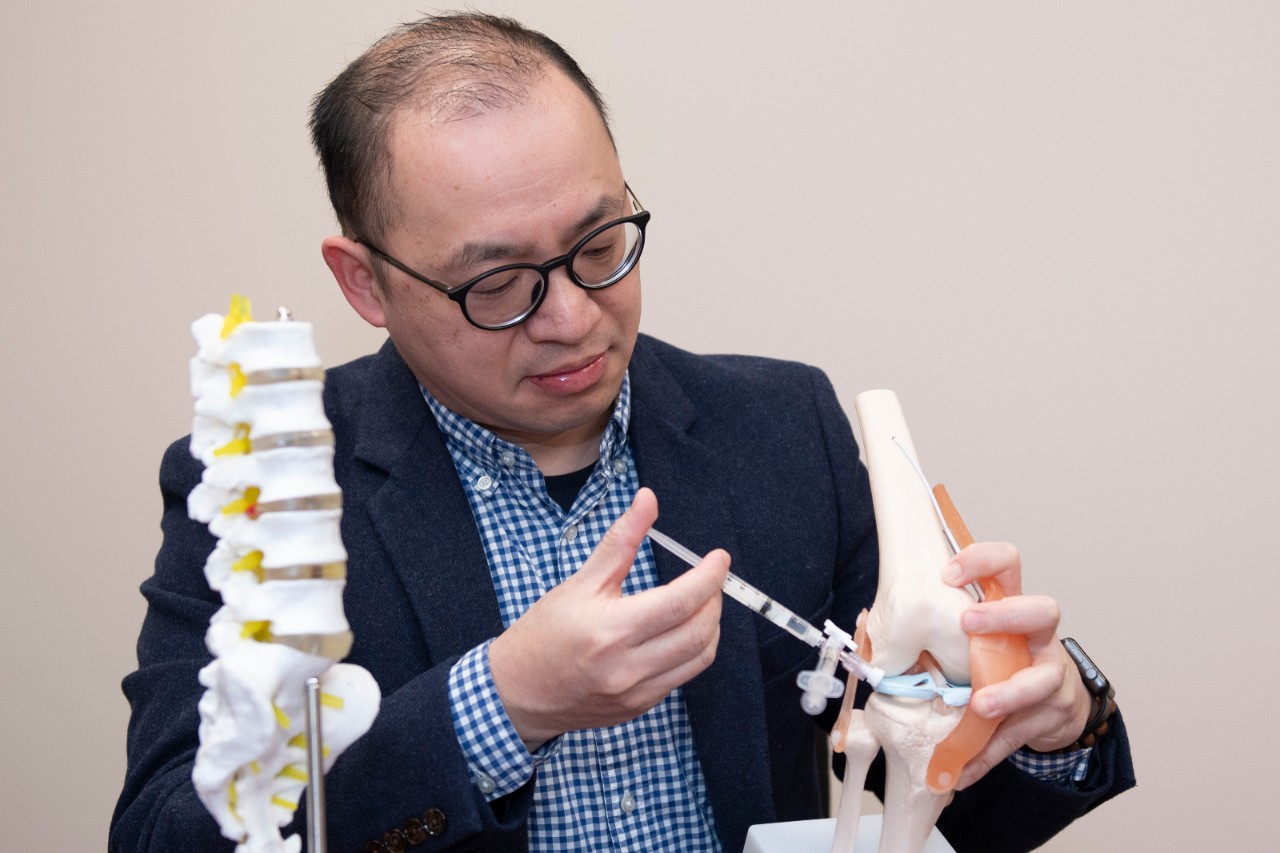
Chia-Ying James Lin, MD, the Mary S. and Joseph S. Stern Jr. Professor and Chair in Musculoskeletal Research in the Department of Orthopaedic Surgery at the UC College of Medicine/Photo/Colleen Kelley/UC Marketing + Brand
AM3101 is an injectable drug being developed as a therapy to reduce the frequency of complications and morbidities associated with failed meniscal repair surgery. Meniscal tears, particularly in the portion of the tissue lacking sufficient blood supply, are often irreparable and require removal of the disease tissue. AM3101 could be added to a repair to allow for successful healing in previous irreparable tear patterns.
Chris Allen, a doctor of physical therapy, is an associate professor in the Department of Rehabilitation, Exercise Science and Nutritional Sciences in the UC College of Allied Health Sciences. He joined the college in 2019 after 20 years as an active-duty military physical therapist.
“The rates of meniscal injury are higher in the military,” Allen says. “These are challenging injuries to manage especially for those who do poorly with surgery. They typically end up medically chaptered out of the military due to poor prognosis. Having an intervention that may reduce those rates would be helpful to improve prognosis.”
AM3101 is developed by Amplicore, a startup biopharmaceutical company led by Chia-Ying James Lin, PhD, the Mary S. and Joseph S. Stern Jr. Professor and Chair in Musculoskeletal Research in the Department of Orthopaedic Surgery at the UC College of Medicine.
“AM3101 is the first of several products being developed based on our novel active pharmaceutical ingredient to reach the clinic,” says Lin. “Our research has shown that it provides pain relief and promotes the regeneration of damaged tissue.”
Grawe says if proven to be successful this treatment could have a positive impact on a wide range of people.
“Meniscus tears are common in both active and inactive individuals,” he says. “This treatment has the possibility to help athletes keep doing the sports they love and keep the ‘average Joe’ from having knee pain. Furthermore, if successful it will keep our troops healthy.”
Grawe says this will hopefully help unlock a “black box” of reliable and restorative healing for a problem that affects millions of Americans.
The trial, which will begin at UC and expand to several other sites, including Walter Reed National Military Medical Center in Bethesda, Maryland, is expected to last two to three years and enroll 74 patients.
Next Lives Here
The University of Cincinnati is classified as a Research 1 institution by the Carnegie Commission and is ranked in the National Science Foundation's Top-35 public research universities. UC's medical, graduate and undergraduate students and faculty investigate problems and innovate solutions with real-world impact. Next Lives Here.
Related Stories
UC Foundation celebrates 2026 philanthropy winners
October 23, 2026
The University of Cincinnati Foundation recognized its Outstanding Philanthropic Volunteer Award honorees at the George Rieveschl Recognition Dinner on October 22, 2026.
AI breast cancer survival model from Cancer Center could improve accuracy and personalize care
October 23, 2026
UC Cancer Center researchers, including lead author Wedad Alatebi, developed a deep learning survival model for breast cancer that combines detailed clinical and genetic information, potentially offering physicians a more accurate tool to guide treatment decisions.
UC expert explains potential impact of Pennsylvania’s new vape product law
October 22, 2026

UC professor Ashley Merianos speaks to the Pittsburgh Post-Gazette about Pennsylvania’s new vape law, youth vaping prevention, enforcement challenges and possible unintended consequences.