
Unlocking how mutations help pancreatic cancer grow
Patra first UC researcher to receive NCI MERIT award

Only about 11% of people will survive five years after the detection of advanced pancreatic cancer. Such a low rate of success in treating pancreatic cancer is due to its late detection and an incomplete understanding of the disease development processes.
Scientists are working in multiple directions to understand the events that contribute to pancreatic cancer development. At the University of Cincinnati, Krushna Patra’s lab is focused on studying how gene abnormalities, or gene mutations, are involved in these processes.
One such project ongoing in Patra’s lab has recently been funded by a National Institutes of Health-National Cancer Institute MERIT Award. Patra, PhD, is the first UC researcher to receive this prestigious award.
Compared to traditional five-year research grants, the Method to Extend Research in Time (R37-MERIT) Award provides the opportunity for longer-term grant support to promising early-stage investigators like Patra.
Learning more about GNAS
Patra studies a number of gene abnormalities involved in pancreatic cancer, including a gene called GNAS. The day-to-day function of the GNAS gene is to maintain body glucose levels and assist in normal development, but when mutated, it becomes overactive and causes cancer.
The GNAS mutation is present in about 8% to 9% of all advanced pancreatic cancer, but it plays a larger role in cancer that develops from pancreatic cysts if other mutations are present in the lesions.
“Pancreatic cysts are akin to ovarian cysts in that they have the potential to develop into full-blown cancer, and the GNAS mutation is found in 50% to 60% of these pre-cancerous growths,” said Patra, University of Cincinnati Cancer Center researcher and assistant professor in the UC College of Medicine’s Department of Cancer Biology.
Cystic pancreatic tumors are very common in otherwise healthy people over the age of 70, Patra said, though not all cysts will progress to pancreatic cancer. But unlike other forms of pancreatic cancer, cystic pancreatic cancer can be detected in very early stages, providing an opportunity for early intervention and treatment.
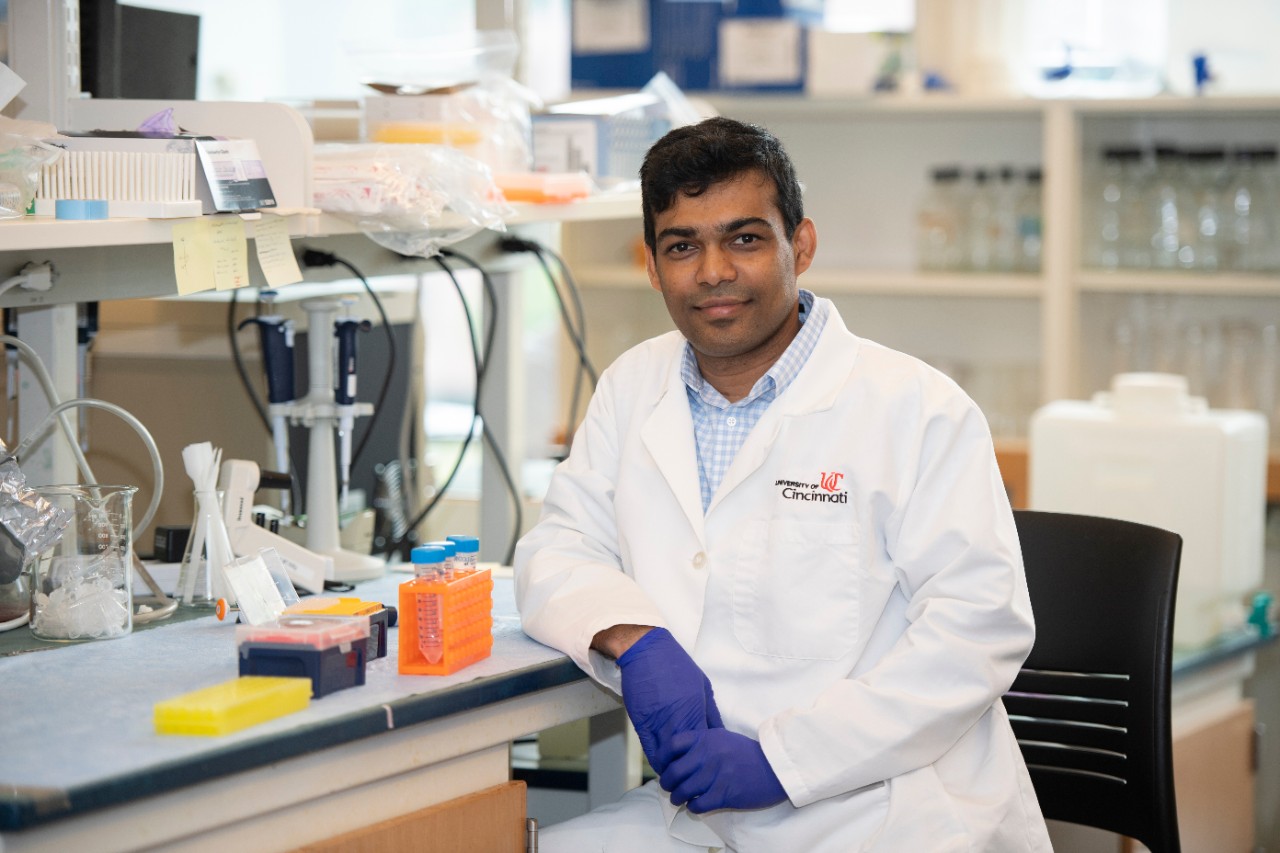
Krushna Patra, PhD, is the first University of Cincinnati researcher to receive a National Cancer Institute MERIT Award. Photo/Colleen Kelley/UC Marketing + Brand.
“If we understand the effects of this GNAS mutation, we can develop treatments or nominate certain patients for surgical intervention, which could prevent the poorest outcomes from ever manifesting,” Patra said.
Patra previously developed one of the first animal models that replicated GNAS mutant pancreatic cancer. Using the model, his team learned that when the GNAS mutation is present in pancreatic cancer, it plays a role in tumor initiation, progression and maintenance. Specifically, GNAS alters the metabolism of cancer cells, creating a metabolic pathway that is unique in GNAS-mutated pancreatic cancer compared to other pancreatic cancer subtypes.
“This NCI award will allow us to recruit talented graduate students and postdoctoral fellows in the lab to study how GNAS changes gene expression and alters mitochondrial structure and function that helps the tumors to grow,” Patra said.
Collaborative environment and inspiration
Patra said he is very excited about the future of the project and credits the environment at the Cancer Center, UC College of Medicine and research affinity groups as keys to his success.
“For example, my Metabolism, Signaling and Therapeutics in Cancer affinity group, which we initiated in conjunction with the Plas, Czyzyk-Krzeska and Cunningham laboratories, provides a forum between collaborators to discuss research progress and refine projects such as this one that ultimately become funded grants and publications,” Patra said. “I am also thankful to many other colleagues including Drs. Jarek Meller, Ken Greis, JJ Diao, Syed Ahmad and Davendra Sohal, whose interactions are vital to the feasibility of this research project.”
As he continues his research, Patra said he is inspired both because of his scientific curiosity of a disease that is not fully understood and through his interactions with patients and their families looking for advancements in treatment options.
“The patients reach out to me, and that is really very motivating and shows us that we have a lot of work to do,” he said.
Next Lives Here
The University of Cincinnati is classified as a Research 1 institution by the Carnegie Commission and is ranked in the National Science Foundation's Top-35 public research universities. UC's medical, graduate and undergraduate students and faculty investigate problems and innovate solutions with real-world impact. Next Lives Here.
Featured photo at top of Krushna Patra in his lab. Photo/Colleen Kelley/UC Marketing + Brand.
In addition to the NCI MERIT award (R37), Patra’s lab is funded by an NCI career development (NCI-K22) award and grants from the Pancreatic Cancer Action Network (PanCAN), University of Cincinnati Cancer Center and UC College of Medicine.
Related Stories
UC Foundation celebrates 2026 philanthropy winners
October 23, 2026
The University of Cincinnati Foundation recognized its Outstanding Philanthropic Volunteer Award honorees at the George Rieveschl Recognition Dinner on October 22, 2026.
AI breast cancer survival model from Cancer Center could improve accuracy and personalize care
October 23, 2026
UC Cancer Center researchers, including lead author Wedad Alatebi, developed a deep learning survival model for breast cancer that combines detailed clinical and genetic information, potentially offering physicians a more accurate tool to guide treatment decisions.
UC expert explains potential impact of Pennsylvania’s new vape product law
October 22, 2026

UC professor Ashley Merianos speaks to the Pittsburgh Post-Gazette about Pennsylvania’s new vape law, youth vaping prevention, enforcement challenges and possible unintended consequences.