
New trial tests chemotherapy regimen following pancreatic cancer surgery
UC’s Ahmad leads SWOG national clinical trial

A new clinical trial is testing the effectiveness of chemotherapy treatment following surgery for a subset of pancreatic cancer patients.
The University of Cincinnati’s Syed Ahmad, MD, is the national principal investigator for the phase 2 Southwest Oncology Group (SWOG) 2104 trial.
Ahmad said he began work on this project several years ago in collaboration with Heloisa Soares, MD, PhD, of the University of Utah, through their collaboration as members of the cooperative SWOG Cancer Research Network.
The trial focuses on patients with pancreatic neuroendocrine tumors. The current standard of care for these patients is surgery only, followed by observation, but a subset of patients are at high risk for their cancer to return, Ahmad said.
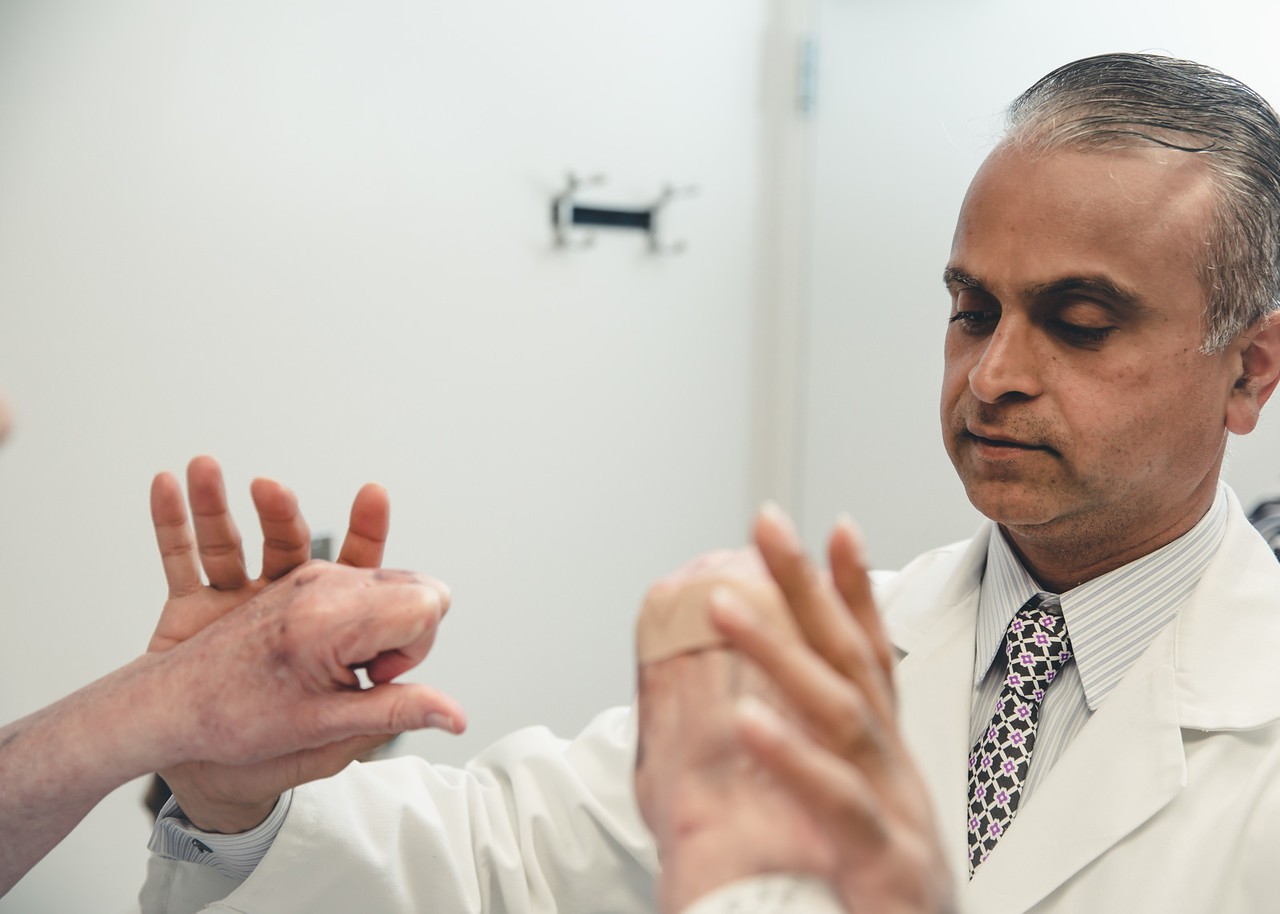
Dr. Ahmad is the principal investigator of the SWOG 2104 clinical trial. Photo/UC Health.
“In the past, we would just watch and wait as no studies had proven beneficial to prevent recurrence," said Ahmad, University of Cincinnati Cancer Center co-director and professor of surgery in UC’s College of Medicine. “However, there was a recent study in patients with advanced cancer showing the efficacy of chemotherapy drugs capecitabine and temozolomide. So we proposed and opened this combination of drugs in patients who have had surgery but are at high risk of recurrence.”
In the trial, patients who have had pancreatic neuroendocrine tumors surgically removed will be randomized to two study arms. Select patients will either receive the two chemotherapy drugs or a placebo.
“The primary endpoint is to see if we can prevent recurrence of the cancer,” Ahmad said. If the treatment regimen proves successful, it could lead to improved survival rates for these patients, he said.
The study has just opened at UC and aims to enroll 150 patients at sites throughout the country. Ahmad said being part of the SWOG Cancer Research Network helps advance research and patient care.
“It allows us to open studies at hundreds of sites to help with trial enrollment,” he said. “It allows us to open novel studies from other institutions so that our local patients have access to cutting edge therapy.”
Next Lives Here
The University of Cincinnati is classified as a Research 1 institution by the Carnegie Commission and is ranked in the National Science Foundation's Top-35 public research universities. UC's medical, graduate and undergraduate students and faculty investigate problems and innovate solutions with real-world impact. Next Lives Here.
Featured photo at top of Dr. Ahmad. Photo/University of Cincinnati Cancer Center.
Related Stories
2026 Daniel Drake Medals awarded to three pioneering physician-scientists
October 12, 2026
The University of Cincinnati College of Medicine awards its highest honor, the 2026 Daniel Drake Medal, to three leaders in transplantation medicine, rare lung disease and heart health.
UC researcher to launch national study with $2.5 million NIH grant
October 9, 2026

A University of Cincinnati researcher has received a $2.5 million National Institutes of Health grant to conduct research during the next five years. Natalie Kreitzer, MD, a University of Cincinnati College of Medicine physician-researcher, received an R01 independent research grant from the NIH's Eunice Kennedy Shriver National Institute of Child Health and Human Development. The funding will support a test program for caregivers of patients with traumatic brain injury, as reported by the Cincinnati Business Courier.
Lighting up the skyline for Blink
October 9, 2026
A team of University of Cincinnati College-Conservatory of Music students designed “Echoes of Light,” a music-and-light installation on Ohio’s largest mural for BLINK, Cincinnati’s massive public light and art festival.