
Business Courier: UC named to national microelectronics hub
Congress awards first Chips Act grants to kickstart microchip manufacturing

The Business Courier highlighted the role institutions such as the University of Cincinnati will play in developing new semiconductors for national security and commerce.
Ohio Gov. Mike DeWine announced this week the Midwest Microelectronics Consortium will receive $24.3 million in partnership with the U.S. Department of Defense. The consortium includes UC along with more than 60 other universities, businesses and government agencies across the Midwest.
The award is the first under Congress’ 2022 Chips and Science Act designed to support semiconductor manufacturing and a secure supply chain within the United States.
UC’s College of Engineering and Applied Science teaches the fundamentals of superconductor design and manufacturing and gives students real-world experience in the Mantei Center’s 8,000-square-foot clean room where they work with equipment similar to the kind found at chip-makers such as Intel.
“Our unique physical and intellectual assets complement the capabilities of the Midwest Microelectronics Consortium partners,” Associate Dean Gautam Pillay said.
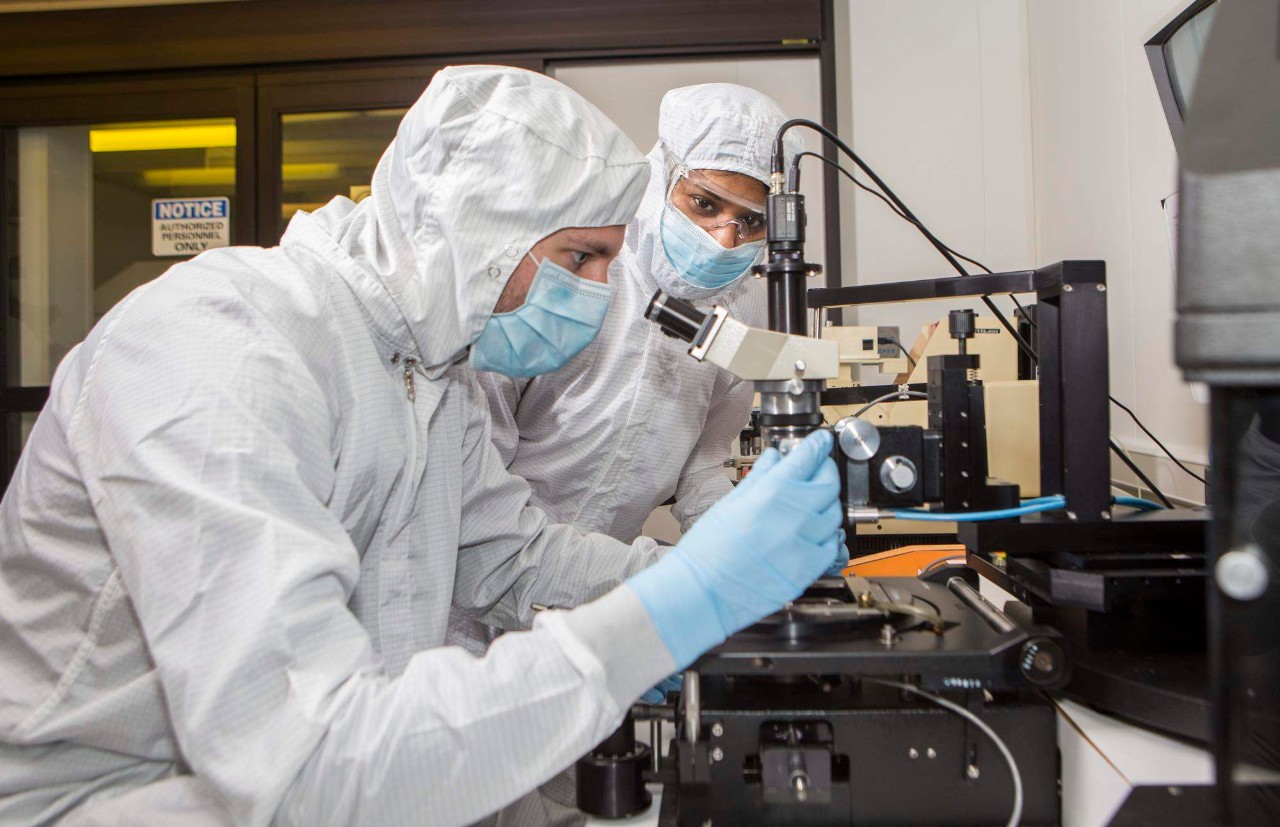
In UC's 8,000-square-foot cleanroom in the Mantei Center, students learn about semiconductor design and manufacturing. Photo/Joseph Fuqua II/UC
The Department of Defense awarded $238 million to create eight microelectronics commons hubs, including the Midwest Microelectronics Consortium to which UC belongs.
Ohio in particular hopes to capitalize on the growing need for state-of-the-art computer chips as Intel Corp. breaks ground on the first of two new fabrication plants off I-71 between Cincinnati and Columbus.
UC leads the Ohio-Southwest Alliance on Semiconductors and Integrated Scalable Manufacturing, or OASIS, which launched a rapid certification program in semiconductor manufacturing that covers topics such as cleanroom practices, chemical safety and the basics of integrated circuit fabrication, among others.
In UC's Advanced Materials Characterization Center, students work with tools such as electron microscopy and X-ray diffractometry. And at the UC-Siemens Simulation Technology Center, students learn to use the latest technology to solve problems across engineering, design and development.
UC is home to the Ohio Cyber Range Institute, dedicated to education, workforce development and entrepreneurship in cybersecurity.
And UC leads the Center for Hardware and Embedded Systems Security and Trust, an industry-university research partnership supported by the National Science Foundation. Its goal is to prevent spying, hacking or cyberattacks of electronics along the supply chain and production line and to detect vulnerabilities that could affect hardware and embedded systems.
Being chosen as a critical hub in the Microelectronics Commons initiative places the Midwest, with leadership from key Ohio institutions, at the heart of American-made semiconductor innovation.
Ohio Gov. Mike DeWine
Ohio hopes to revolutionize the “lab-to-fab” microelectronics industry that leans heavily on semiconductor research at institutions such as UC to create the next generation of microchips.
“Being chosen as a critical hub in the Microelectronics Commons initiative places the Midwest, with leadership from key Ohio institutions, at the heart of American-made semiconductor innovation,” DeWine said.
According to the governor’s office, the United States is a leader in microelectronics design but accounts for just 12% of global microelectronics production. The goal of the Chips and Science Act is to kickstart U.S. manufacturing to protect the supply chain and intellectual property.
Among other things, the federal money will pay for workforce training and semiconductor research.
The consortium partners include local institutions such as Miami University, Ohio State University and Wright State University, government institutions such as the U.S. Department of Energy’s Argonne National Laboratory along with companies such as Intel, Siemens, Raytheon Technologies and Lockheed Martin.
Featured image at top: UC is preparing workers for careers in semiconductor manufacturing. Photo/Andrew Higley/UC Marketing + Brand

The Ohio Cyber Range Institute conducts a cybersecurity exercise at UC's Digital Futures building. Photo/Joseph Fuqua II/UC
Related Stories
Women consistently experience more pain than men across 11 body parts
October 12, 2026

A large global study spanning 118 countries, published in Nature Medicine, has found that women consistently report more pain than men across 11 bodily sites, including the back, head, face, knees, chest, abdomen and hips. The study also found that, across sexes, the sharpest increases in self-reported pain tend to occur before age 55. These findings may inform a new approach to chronic pain prevention and management throughout the lifespan. Shuchita Garg, MD, an associate professor of clinical medicine at the University of Cincinnati College of Medicine, Division of Chronic Pain, within the Department of Anesthesia, and the medical director of the UC Medical Center Pain Clinic, who was not involved in this study, commented on the findings for Medical News Today (MNT).
Some physicists question existence of dark energy
October 12, 2026

The BBC examines how physicists are at odds over the prevailing theory about dark energy in the universe.
2026 Daniel Drake Medals awarded to three pioneering physician-scientists
October 12, 2026
The University of Cincinnati College of Medicine awards its highest honor, the 2026 Daniel Drake Medal, to three leaders in transplantation medicine, rare lung disease and heart health.