
Makerspace boot camp fast-tracks training for student co-ops
UC students are ready for work on day one at professional engineering firms

In a groundbreaking collaboration, the University of Cincinnati's Ground Floor Makerspace and Kinetic Vision have launched an immersive makerspace boot camp designed specifically for UC co-ops. This custom training program equips students with the skills and experience needed to begin contributing effectively from their first day at a professional engineering company.
The boot camp provides hands-on training in critical areas such as manufacturing design techniques, safety protocols and advanced digital fabrication tools. By fast-tracking this training, employers benefit from co-ops who are prepared to tackle real-world challenges and ready to integrate seamlessly into their teams, reducing onboarding time and increasing productivity. UC’s makerspace initiative underscores its commitment to cultivating a workforce that’s immediately impactful and well-prepared for the demands of the engineering industry.
Kinetic Vision comes to UC
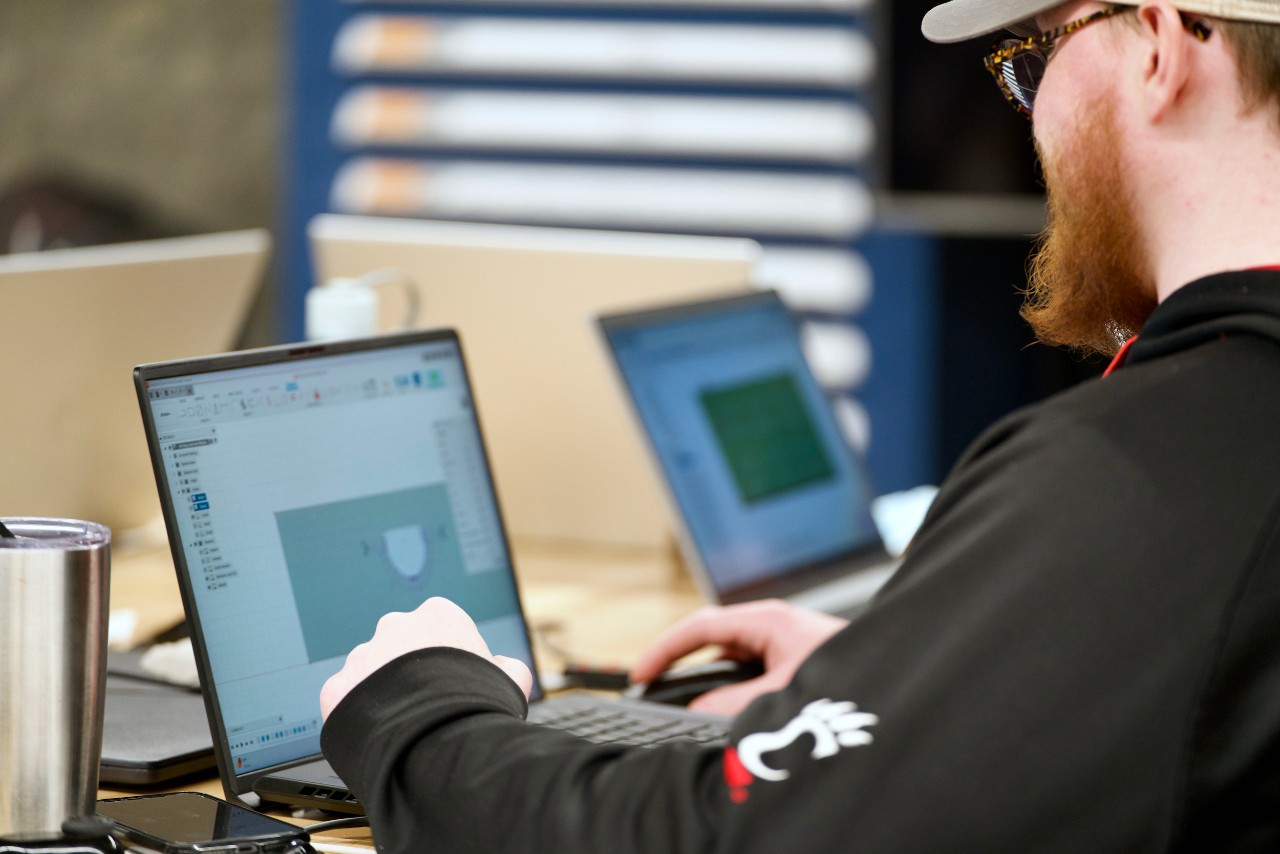
The five-day Kinetic Vision co-op makerspace boot camp takes command of the UC Ground Floor Makerspace starting on Jan. 13, immersing participants in a whirlwind of innovation toward several goals. These include cultivating a deeper understanding of manufacturing design through laser cutting, 3D printing and computer numerical control (CNC) machining, gaining experience in a new computer-aided design language, going through safety training, working with equipment and enjoying camaraderie with other co-ops.
Surrounded by advanced technical tools, engineering and industrial design co-op students will seamlessly blend into the hands-on training sessions. Navigating state-of-the-art digital fabrication prototyping equipment inside the makerspace, they should feel right at home embracing innovation.
“These students were already hand-selected by Kinetic Vision because they were at the top of their skill levels, so we’ll simply give them the opportunity to work on a project collaboratively over the course of the week,” says Benjamin Jones, director of the 1819 Ground Floor Makerspace. “We’ll give them hands-on training in the makerspace, which is largely translatable to what they will do at Kinetic Vision, but more importantly, we’ll give them that week to jump-start their relationships and become colleagues.”
Justin Rost, lead design engineer at Kinetic Vision, recognizes the pivotal significance of student bond-building endeavors. “It’s great for students to be able to collaborate with their peers, build rapport with one another and learn how to work as a team in a challenging environment.”
Creative immersion
Photo/Aidan Wallace/UC Office of Innovation
Throughout the boot camp, UC students will embark on a deep dive into the theory and safe handling of digital fabrication tools, spotlighting the world of CO2 laser engraving. As the week unfolds, participants will conquer the realms of desktop and industrial fused deposition modeling.
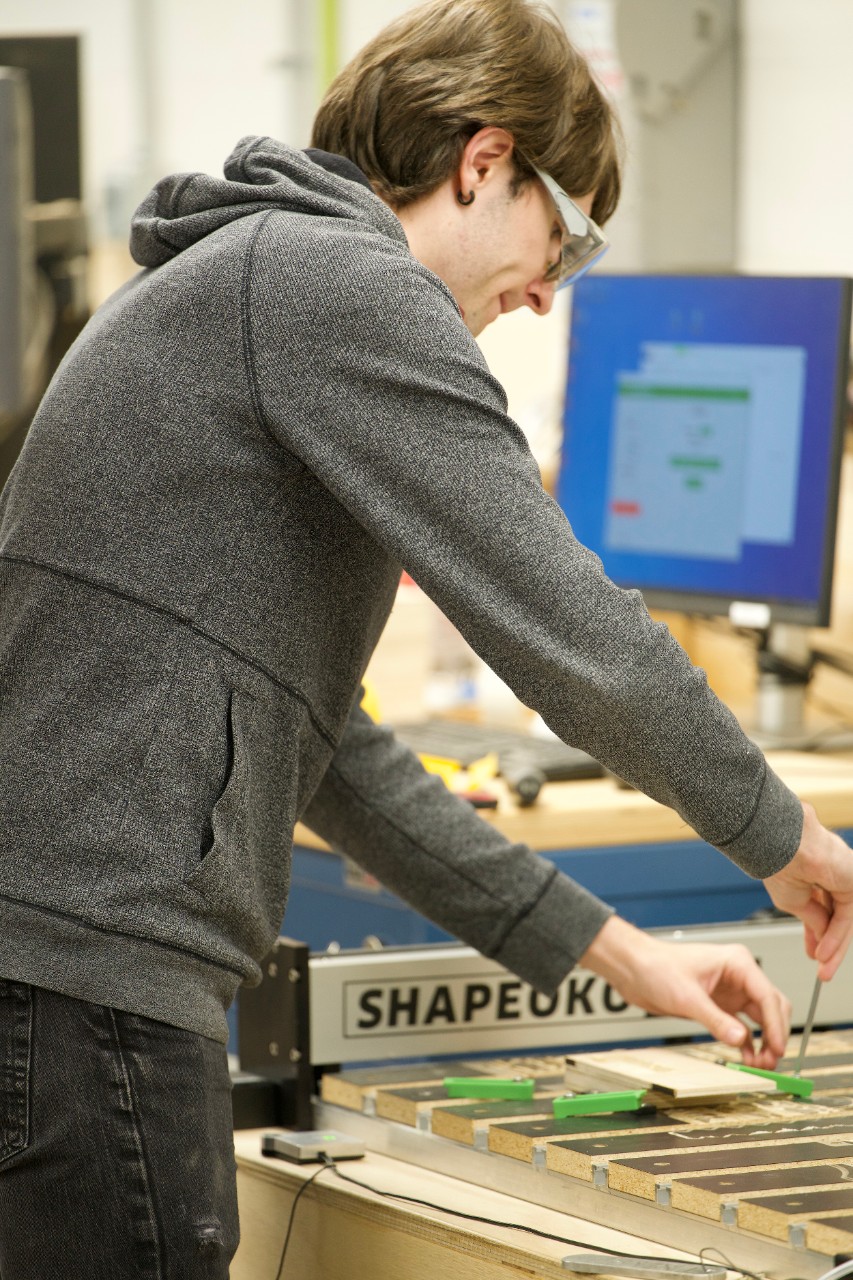
“Partnering with the 1819 Innovation Hub for this boot camp allows students to not only design parts for CNC machining, but work directly with the machinist to learn firsthand the impact their design choices have,” Rost says.
While the students have access to technical guidance to ensure that what they’re doing makes sense and is practical, Jones says the creative problem-solving is their own.
Keys to success
Photo/Aidan Wallace/UC Office of Innovation
Guided by Jones, Rost and a team of makerspace staff, co-op students will both gain technical skills and learn safety principles while developing self-efficacy, resilience, communication finesse and unwavering attention to detail.
“One of the goals we’re after is not to create machine operators, but to create designers who are well versed in the technologies for which they are designing,” Jones says. “The point is not to turn them all into CNC machinists, but to develop a practical knowledge of what is involved with these processes, giving them a deeper understanding of costs and opportunities inherent in their decisions as designers.”
With a focus on practical, real-world applications, the boot camp equips participants with valuable skills, preparing them for the challenges of the ever-evolving field of digital fabrication and design for manufacturing.
Kinetic Vision is one of UC’s largest co-op employers, and Rost says Bearcat students have been imperative to the company’s success. “We are always looking for ways to improve our co-op program and provide more valuable experiences to students, and we’re happy to say that the boot camp has been a resounding success,” Rost says. “I’m looking forward to continuing to build and improve the event and provide this experience to many more co-ops for semesters to come.”
Featured image at top: UC co-op students discussing innovative design for manufacturing during the 2024 makerspace boot camp. Photo/Aidan Wallace/UC 1819 Innovation Hub
Innovation Lives Here
The University of Cincinnati is leading public urban universities into a new era of innovation and impact. Our faculty, staff and students are saving lives, changing outcomes and bending the future in our city's direction. Next Lives Here.
Related Stories
UC aerospace engineer leads global computational fluid dynamics taskforce
October 21, 2026
The American Institute of Aeronautics and Astronautics' CFD 2030 Integration Committee has announced the formation of the Computational Fluid Dynamics (CFD) Vision 2045 Team, a multi-institution working group tasked with defining where the field of computational fluid dynamics should be by 2045 to align with the changing and evolving needs of the aerospace industry. The University of Cincinnati's Prashant Khare, Bradley Jones professor and head of the Department of Aerospace Engineering, is leading this specialized group.
Still the top ‘cat
October 20, 2026

The University of Cincinnati Bearcat mascot was voted Cincinnati’s favorite mascot in a Cincinnati Enquirer reader poll, earning 45.1% of the vote and topping other local favorites.
Researchers test gene therapy as less invasive treatment for hydrocephalus
October 20, 2026

Researchers at the University of Cincinnati College of Medicine say an experimental gene therapy could eventually lead to a less invasive treatment for hydrocephalus, a condition in which excess fluid accumulates in the brain. The early-stage study, led by Agnes (Yu) Luo, PhD, professor and vice chair for research, was published in the journal Fluids and Barriers of the CNS. Yahoo! News recently featured it.