
New AI predicts anxiety levels
Minimal computations, small variable set predicts whether someone has potentially dangerous stress

Researchers at the University of Cincinnati developed a new form of artificial intelligence that uses a short picture rating task and a small set of contextual variables to predict whether someone is experiencing anxiety.
Anxiety can be functionally impairing, affecting 12% of the U.S. population as a leading cause of disability. It’s characterized by intense fear and persistent worry in the absence of a defined threat. Chronic anxiety can harm a person’s mental and physical health and affect relationships, careers and quality of life.
“I feel anxiety is experienced by everyone at different levels, at different stages in life, and is a relatable issue for most people,” said Sumra Bari, first author and a senior research associate in UC's College of Engineering and Applied Science.
“We used minimal computational resources and a small set of variables to predict anxiety levels. An important set of these variables quantify processes important to judgment. We have named this approach ‘Comp Cog AI’ given it integrates computational cognition with artificial intelligence.”

UC Professor Hans Breiter. Photo/Andrew Higley/UC Marketing + Brand
Instead of sorting through reams of social, medical or psychological data (one aspect of “big data”) and using supercomputers with significant energy demands, this technique focuses on a short rating task where the individual assigns positive or negative ratings to pictures and responds to a limited set of contextual questions, such as age and loneliness.
“There has been a major focus on using big data for prediction,” said Hans Breiter, co-author and contact principal investigator of the study.
Breiter is a professor of computer science and biomedical engineering at the University of Cincinnati, and adjunct in psychiatry at Massachusetts General Hospital and Harvard Medical School.
“Big data-based prediction is powerful but is challenged by how one interprets such predictions,” he said.
“Having a small number of variables grounded in mathematical psychology appears to get around this issue and is needed if current machine learning is ever going to approach the issue of artificial general intelligence, or what brains do routinely for multiple cognitive functions. The current work is based on a set of equations about human judgment that support the concept of what other AI scientists are calling a ‘standard model of the mind.'”
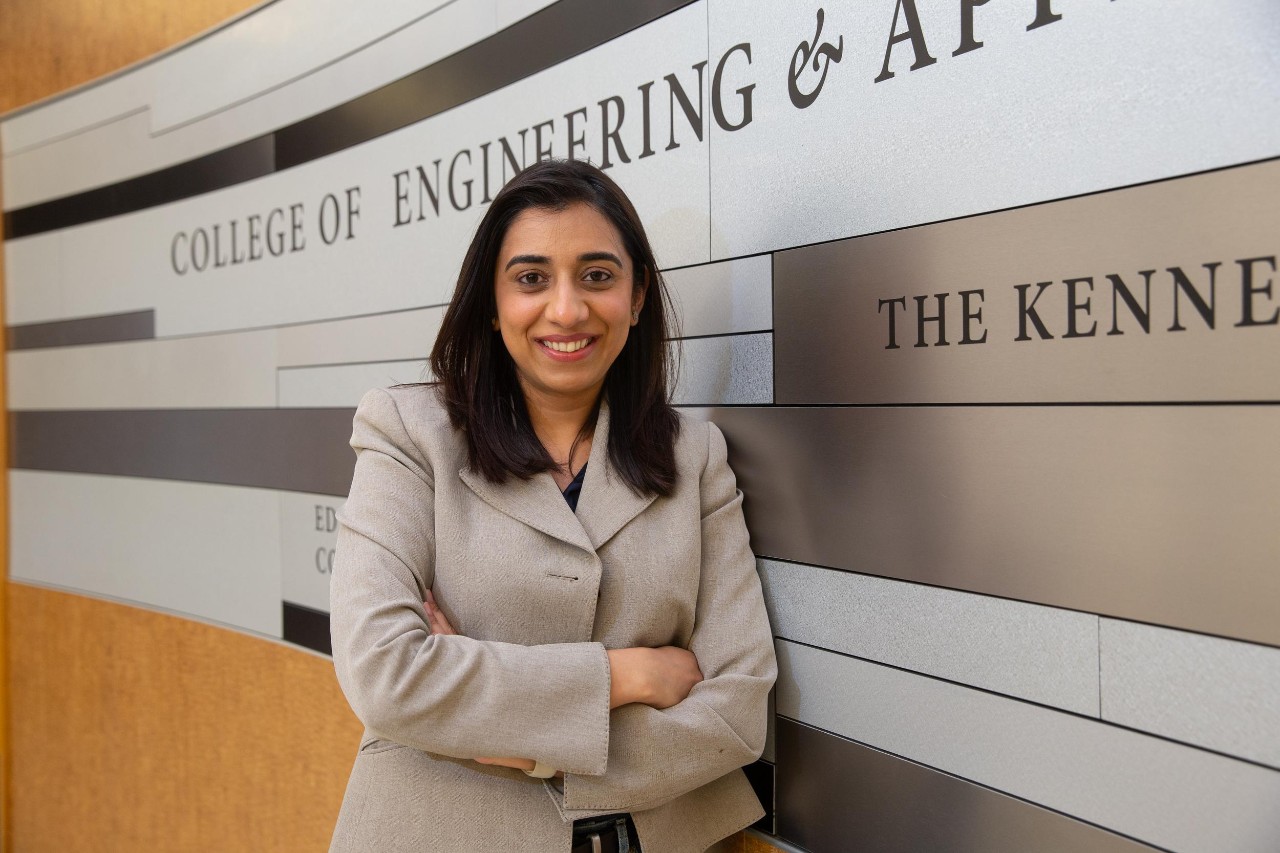
Senior Research Associate Sumra Bari is investigating new health applications for artificial intelligence in UC's College of Engineering and Applied Science. Photo/Andrew Higley/UC Marketing + Brand
The study was published in Nature Portfolio Journal, Mental Health Research. It concluded that judgment measures with some demographics play a key role in predicting the degree of anxiety experienced by an individual.
The system represents a “concierge prototype” of a tool that could be an app for medical professionals, hospitals or the military to identify those who have an urgent risk of anxiety.
Participants, whose demographics mirrored those of the United States based on U.S. Census Bureau figures, completed the study survey on their personal digital devices and answered questions about demographic characteristics and perceived loneliness. These 3,476 participants also rated the degree to which they liked or disliked 48 pictures with mildly emotional subject matter. The picture rating data were used to quantify mathematical features of people’s judgments. These data were then used with machine learning algorithms to predict current levels of anxiety from the state anxiety portion of the State-Trait Anxiety Inventory.
“Use of a picture rating task with contextual variables that affect judgment may seem simple, but understanding patterns in preference allows us to uncover the critical components for a large set of behaviors,” said co-senior author Aggelos Katsaggelos, the Joseph Cummings Professor of Electrical and Computer Engineering at McCormick and director of the Image and Video Processing Lab at Northwestern University.
Using this novel form of artificial intelligence developed by UC and Northwestern, the technology was able to predict whether a respondent was likely to suffer from a higher or lower level of anxiety with up to 81% accuracy. The system also scored high in sensitivity and specificity — performance measures indicating how well the model classified people who have higher anxiety and those who don’t.
Bari noted “the picture-rating task can be used to produce daily and unbiased snap shots of a person’s mental health status without asking direct questions which may trigger negative or upsetting feelings.”
She added that direct questions about anxiety may be less effective over time as respondents eventually tend to answer the same questions by rote. The new technology is also independent of native language and can be widely used across a variety of settings to assess anxiety.”
Researchers noted that the anonymous data were sampled from the U.S. population during the COVID-19 pandemic, during which there were reports of higher-than-normal rates of loneliness and anxiety.
The study was funded by two grants to Breiter from the U.S. Office of Naval Research. Breiter, Bari and Nicole Vike, along with engineer Byoungwoo Kim, collaborated on the study with investigators from Northwestern University including Shamal Lalvani, Leandros Stefanopoulos, Martin Block, and Katsaggelos (co-senior author) and Nicos Maglaveras from The Aristotle University of Thessalonik.
Massachusetts General Hospital (Harvard School of Medicine) was also actively associated with this work, where the research team led by Breiter initially uncovered the computational cognition underlying the work.
Featured image at top: Senior Research Associate Sumra Bari is investigating new health applications for artificial intelligence in UC's College of Engineering and Applied Science. Photo/Andrew Higley/UC Marketing + Brand
Innovation Lives Here
The University of Cincinnati is leading public urban universities into a new era of innovation. Our faculty, staff and students are saving lives, changing outcomes and bending the future in our city's direction. Next Lives Here.
Related Stories
Environmental engineer researching methods to monitor river quality
October 16, 2026
Pradeep Ramtel has been conducting research on river water since he was an undergraduate student in Nepal. He is currently a PhD student at the University of Cincinnati and is studying under Associate Professor Dongmei Feng. His research uses collected data and machine learning to better assess risks to river water quality and prepare for problems before they arise. Recently, he was named Graduate Student Engineer of the Month by UC's College of Engineering and Applied Science.
Collaboration over consultation
October 16, 2026
New University of Cincinnati research published in the journal Health Expectations found stroke survivors participating in rehab research desire an approach that prioritizes shared decision-making, peer relationships and a focus on what they can accomplish rather than their deficits.
Cincinnati Spotlight features CCM's new Conservatory Series concerts
October 15, 2026

Cincinnati Public Radio features CCM's new Conservatory Series in its latest "Cincinnati Spotlight." The series launches on Wednesday, Oct. 21 with its inaugural "Grand Tradition" concert featuring a variety of CCM's distinguished faculty artists.