
UC researchers to study presence of MRSA in air in hospital settings
College of Medicine, Nursing researchers receive grant to conduct environmental surveillance

Even in a post-pandemic world, frontline health care workers face many occupational challenges, and exposure to infection is among them.
Now, University of Cincinnati scientists are working to minimize health care workers’ exposure to MRSA, or methicillin-resistant Staphylococcus aureus, a type of staph bacteria that's become resistant to many of the antibiotics used to treat ordinary staph infections.
Most MRSA infections occur in people who've been in hospitals or other health care settings, making it a particular risk to those who work in such facilities, and a team of UC researchers has been awarded a $300,000 grant from the Ohio Bureau of Workers’ Compensation to conduct environmental surveillance at University of Cincinnati Medical Center.
MRSA is primarily transmitted through person-to-person contact and contact with contaminated surfaces, but experts have emerging evidence of the presence of MRSA in the air in hospital settings. As of 2021, Ohio had an incidence of MRSA that's greater than the national incidence, according to the state department of health.
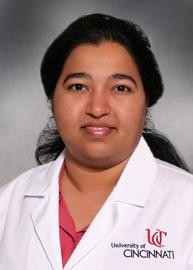
Sripriya Nannu Shankar, PhD/Photo/provided
The study’s lead author is Sripriya Nannu Shankar, PhD, assistant professor in the Division of Environmental and Industrial Hygiene in the Department of Environmental and Public Health Sciences at the College of Medicine. Shankar and colleagues will try to get a better grasp on the presence of MRSA in the air and the significance of airborne transmission of MRSA.
Researchers will conduct laboratory and field work at UC Medical Center, where an air sampler in three of the units will collect particles laden with microbes.
Even if MRSA is detected, Shankar said UC Medical Center employees can be assured that their risk is low with current control measures.
“As we know from COVID-19 research, mere detection of a pathogen doesn't mean it can cause infection,” she said. “The microbe should be live or viable to cause an infection.”
Researchers will also study the effectiveness of the current control measures, which include regular testing of admitted patients, periodic disinfection and high air exchange rates within the hospital. They will also study the effectiveness of alternate methods of inactivating MRSA, such as UVC light sterilizers, disinfectant sprays and air purifiers.
Shankar explained that if researchers discover that MRSA is live, they will follow protocols to disinfect the air and make recommendations to further enhance workplace safety.
“Our team will also seek input from hospital workers about current protocols and potential changes in the future,” she said. “We expect existing policies to minimize the risk of MRSA exposure to workers and patients. Our study gives an added layer of confidence that the risk of exposure to MRSA is minimal to none in their units.”
One of Shankar’s collaborators explained the significance of how they are conducting their work.
“Understanding this unique environment is key to being able to collect samples and interact with hospital staff,” said Elizabeth Bien, PhD, assistant professor in the College of Nursing. “As a previous infection preventionist and an occupational health nurse who was trained to focus on the worker as a patient, I am excited to partner on this work.”
The study team also includes Jagjit Yadav, PhD, from the Department of Environmental and Public Health Sciences; Vivek Narendran, MD, in the Division of Neonatology in the Department of Pediatrics and a Cincinnati Children’s Hospital physician; and industry collaborator Arantzazu Eiguren-Fernandez, senior research chemist at Aerosol Dynamics Inc.
Featured image at top: A Petri dish with bacteria growing inside. Photo/Provided
Impact Lives Here
The University of Cincinnati is leading public urban universities into a new era of innovation and impact. Our faculty, staff and students are saving lives, changing outcomes and bending the future in our city's direction. Next Lives Here.
Related Stories
UC researcher to launch national study with $2.5 million NIH grant
October 9, 2026

A University of Cincinnati researcher has received a $2.5 million National Institutes of Health grant to conduct research during the next five years. Natalie Kreitzer, MD, a University of Cincinnati College of Medicine physician-researcher, received an R01 independent research grant from the NIH's Eunice Kennedy Shriver National Institute of Child Health and Human Development. The funding will support a test program for caregivers of patients with traumatic brain injury, as reported by the Cincinnati Business Courier.
Lighting up the skyline for Blink
October 9, 2026
A team of University of Cincinnati College-Conservatory of Music students designed “Echoes of Light,” a music-and-light installation on Ohio’s largest mural for BLINK, Cincinnati’s massive public light and art festival.
Simple ways to find a deeper sense of happiness and well being
October 8, 2026

UC assistant professor Suzie White, featured in an AARP story on practical ways to live a happier, healthier life, shared research-backed strategies for increasing well-being through gratitude and service to others. White teaches Happiness in Action, a course that helps students apply the science of happiness in everyday life.