Ticks that survive pesticides can withstand colder winters
Pesticides could help tick-borne illness spread farther north, UC study finds

Ticks that survive less-than-lethal doses of pesticide are able to withstand dangerous cold, which could help them spread tick-borne diseases farther north.
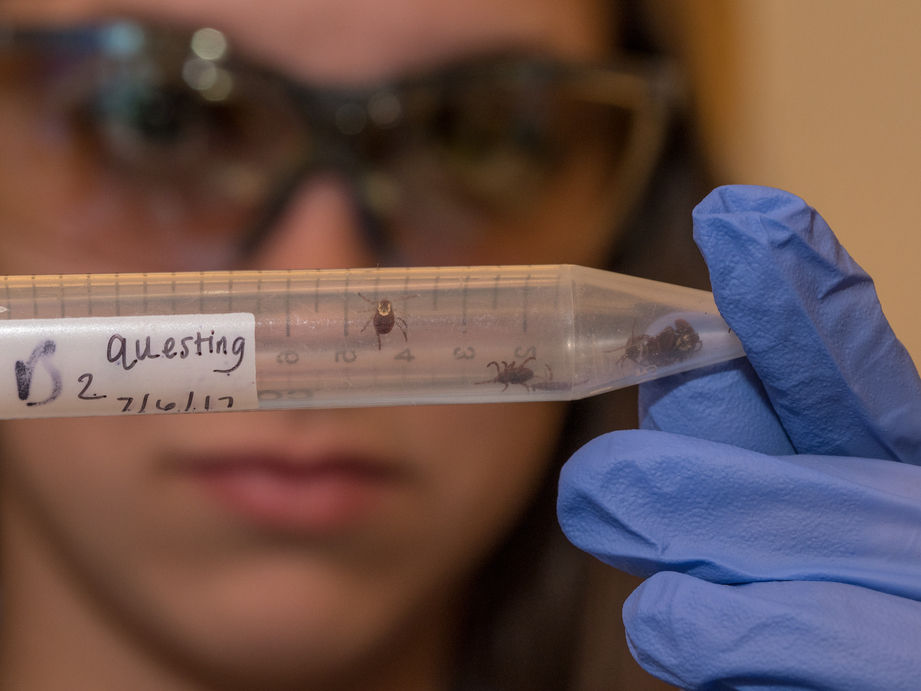
Biologists with the University of Cincinnati and the U.S. Department of Agriculture examined the effects of pesticide on two common species of dog tick.
Ticks were exposed to two broad-spectrum insecticides and then exposed to two hours of intense cold between -16 degrees and -28 degrees. About half the ticks survived exposure to -16 degrees while virtually none survived temperatures of -28 degrees.
UC students also mimicked overwintering conditions typical for the West and Midwest where dog ticks are common. They buried ticks 10 centimeters underground in enclosures in Crooks, South Dakota, and Cincinnati, Ohio, between September and April.
Researchers expected that ticks exposed to pesticides would be more susceptible to cold, but they found the opposite.
“This study highlights an unintended consequence of pesticide exposure,” co-author and UC College of Arts and Sciences Professor Joshua Benoit said. “Chemicals designed to suppress tick populations may increase tick cold tolerance.”
The study was published in the British Ecological Society’s Journal of Applied Ecology.

UC Professor Joshua Benoit, left, talks to Spectrum News reporter Travis Hicks in a biology lab. Benoit warns that some species of tick are expanding their range into new places, exposing people to tick-borne illness. Photo/Michael Miller
How do pesticides make ticks more resistant to cold?
“Many pesticides act as physiological stressors. When ticks survive exposure, they may activate broad pathways that help protect against multiple forms of stress,” Benoit said. “Because some of these protective mechanisms are shared between pesticide tolerance and cold tolerance, exposure to pesticides may produce a phenomenon known as cross-tolerance, where surviving ticks become better able to withstand low temperatures.”

UC students are studying ways to combat tick-borne illness in Professor Joshua Benoit's lab. Photo/Joseph Fuqua II/UC
Benoit and his students study ticks, mosquitoes and other disease vectors in his biology lab.
Ticks can carry diseases such as Rocky Mountain Spotted Fever, Lyme and Ehrlichiosis, which can be debilitating and persistent.
Benoit said cold winters have been a reliable backstop against the northern spread of cold-sensitive ticks.
“If pesticide exposure increases the ability of ticks to survive winter conditions, populations may establish and persist in areas that were previously too cold,“ he said.
And that could lead to exposures to tick-borne illnesses in regions that until now have been tick-free, he said.
The study was led by former UC postdoctoral researcher Kennan Oyen, now at the USDA. UC students Thomas Arya, Benjamin Davies and Elise Didion also contributed to the study.
Benoit and UC students Kosisochukwu Onyeagba and Joshua Tompkin spoke to Spectrum News about how some species of ticks are expanding their range and what UC is doing to find ways to prevent tick-borne illness.
“In the last few years we're starting to see more black-legged ticks, which carry Lyme disease,“ Benoit said.
And Benoit said Gulf Coast ticks are also showing up in new places. They are known to carry spotted fever.
Benoit said students in his lab are learning more about tick physiology to develop better ways to prevent exposure to tick-borne illness without deploying dangerous pesticides. Onyeagba is studying ways to interrupt the tick's ability to sense environmental humidity, key to its survival.
Featured image at top: UC researchers spoke to Spectrum News about ways UC is trying to stem tick-borne illness. Photo/Jay Yocis/UC
Frequently asked questions about UC's tick research
What are ticks?
Ticks are parasites that feed on host animals to survive. Ticks are related to spiders with eight legs. Worldwide, there are more than 900 species of ticks but only a few bite people.
What diseases do ticks carry?
Ticks can carry a variety of diseases, depending on their species. Blacklegged ticks can carry Lyme disease, which can cause arthritis, nerve pain and neurological impairment. Dog ticks can carry Rocky Mountain Spotted Fever, which can cause swollen joints and neurological impairment, and Ehrlichiosis, a bacterial infection that can harm white blood cells. Lone Star ticks found in the southern United States can carry Ehrlichiosis as well along with Alpha-gal Syndrome, which can lead to severe allergies to red meat and the many medicines like insulin and blood thinners derived from animal tissue.
Why are researchers studying ticks?
Ticks can carry debilitating diseases that can infect people and pets. And some species of ticks are expanding their range into new areas, exposing more people to these diseases.
What is UC learning about ticks?
UC Professor Joshua Benoit and his students discovered that ticks exposed to sublethal doses of pesticide paradoxically developed resistance to cold temperatures that otherwise would have killed them. They warn that pesticides could allow ticks to expand their range into colder, northern states where harsh winters previously provided a backstop against the spread of tick-borne illness.
Related Stories
These teeny spiders are social media stars
August 28, 2026

The New York Times turned to a University of Cincinnati professor to explain the appeal of jumping spiders on social media.
Scientists discover how snakes stand upright without limbs
April 3, 2026

Smithsonian magazine highlights a study co-authored by UC Professor Bruce Jayne, an expert in snake locomotion, about how snakes stand upright without arms or legs.
A robot bat sheds light on how they hunt in the dark
January 20, 2026

Popular Science and other outlets highlight an engineering-inspired biology study examining how bats find hidden prey in thick foliage at night.