How two UC co-ops joined Procter & Gamble for fast-track innovation
A behind-the-scenes look inside the Learning Lab at 1819 Innovation Hub

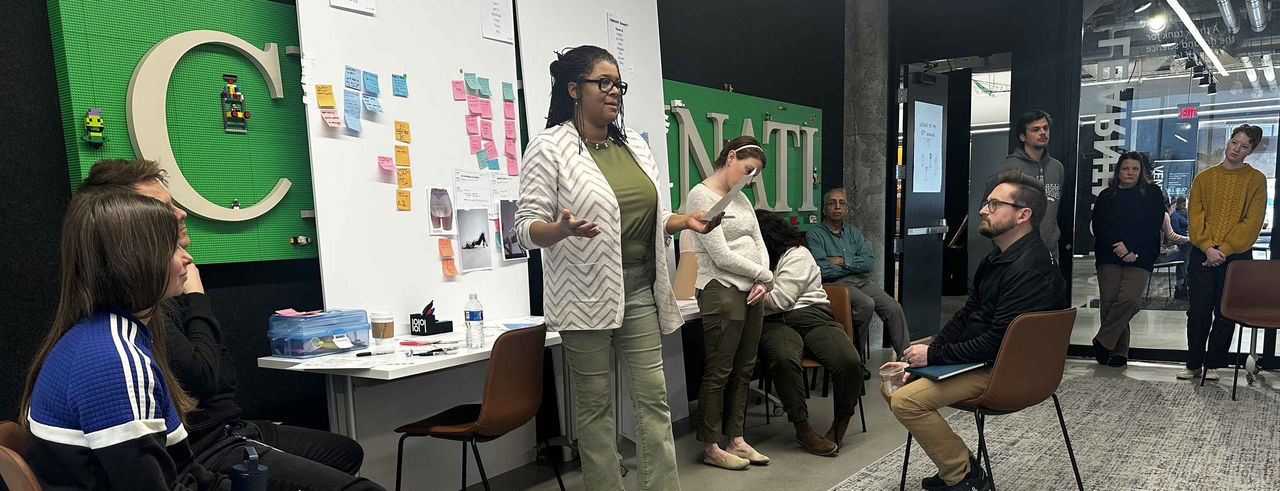
A whiteboard disappears beneath a mosaic of Post-it notes. Teams cluster around the room, voices overlapping and ideas flying. This is an energy-filled glimpse of how early-stage product innovation begins to take shape.
When University of Cincinnati (UC) co-op students Ally Mescher and Ellie Morrison stepped into the Learning Lab at the 1819 Innovation Hub that day, they expected to observe a workshop with Procter & Gamble (P&G). Instead they found themselves immersed in a fast-paced, collaborative design sprint gaining a behind-the-scenes look at how a global company brings early-stage product ideas to life, from initial concepts to visualization and development.
Opportunities like these are a hallmark of UC’s renowned cooperative education (co-op) program which connects students with real-world experiences alongside their academic studies. The co-op program is nationally ranked and works with over 1,700 employer partners to provide students with opportunities to apply what they learn in the classroom and last year alone, UC had 9,614 co-op placements.
Their day inside the Learning Lab became a powerful example of how experiential learning can bridge the gap between classroom theory and professional practice.
A classroom unlike any other

Director of the Learning Lab, Nicholas Partridge. Photo/Greg Glevicky
Both students immediately noticed how different the Learning Lab felt from a traditional meeting room. The space was intentionally designed for collaboration and creative energy, encouraging movement, brainstorming and rapid idea generation.
Director of the Learning Lab, Nicholas Partridge, and team members Rebecca Rudolph and Kurt Myers collaborate with corporate partners of the 1819 Hub to design hands-on learning experiences around real business challenges, helping teams build capability while advancing important work.
"Our staff acts as connectors and catalysts, bringing together professional and academic talent to work alongside corporate partners. We create hands-on experiences that mirror their needs and the pace and energy of real-world innovation," said Nicholas Partridge, director of the Learning Lab.
For P&G professionals, stepping away from their desks into new surroundings and working with the Learning Lab team's strategic guidance helped spark fresh thinking on an early-stage product innovation challenge whose details remain proprietary.
The students were not there to simply observe. They were placed into teams alongside these professionals and encouraged to contribute.
"We structured a design sprint for P&G, providing an environment that encouraged open participation, which on occasion can include our UC faculty or, in this case, our co-op students," explained Partridge.
Morrison and Mescher rotated through groups, helped visualize ideas, asked questions and offered suggestions. Rather than simply observing the process, they contributed alongside P&G professionals as ideas were generated, developed and refined.
This immersion allowed them to witness how early ideas can quickly evolve through collaboration, ultimately leading to collective voting on the most promising concepts.
How real teams think

Procter & Gamble team ideates inside the UC 1819 Learning Lab. Photo/Mary Dwyer.
Behind the scenes, the Learning Lab, part of the 1819 Partner Success team, plays a fundamental role in making sessions like this possible. They structured the session as a design sprint, with participants divided into rotating teams that tackled different aspects of a shared challenge. This format maintained momentum and let ideas evolve quickly as groups built on one another’s work.
“By the end of the session, focused on meeting the needs of our corporate partner, we also wanted Ellie and Ally to experience the same collaborative cadence used by professionals tackling real-world challenges," said Partridge. "It exposed them to how a new environment, diverse perspectives and strategic guidance can influence how teams learn and innovate."
Throughout the workshop, the 1819 co-op duo observed how cross-functional innovation teams operate across disciplines.
"Seeing how many perspectives come together to shape a single idea completely changed how I think about teamwork and creativity," said Mescher. "Being a part of it in real time made a lasting impression."
- Engineers contributed technical insights.
- Creative professionals translated those insights into storytelling and visual concepts.
- Other team members brought consumer, product and business perspectives that helped sharpen and advance the ideas.
Rather than working in silos, teams from across P&G actively informed and elevated one another, giving the students a firsthand look at cross-functional collaboration in action.
"Being part of the brainstorming process helped me realize how far an idea can evolve when different departments and disciplines collaborate," said Morrison.
Technical details sparked creative ideas, which in turn helped teams find clearer, more intuitive ways to communicate product benefits. The result was a continuous feedback loop that strengthened every concept.
For the students, the experience demonstrated that innovation rarely comes from a single perspective. It thrives when diverse expertise is invited into the same conversation.
Consumer-first thinking in action

Mescher and Morrison (foreground) take a behind the scenes look at the P&G creative process as a team works to bring a product to life. Photo/Mary Dwyer.
One theme the co-ops noticed repeatedly throughout the Learning Lab session was that the consumer must remain at the center of every decision.
"My encounter with Procter and Gamble team members helped me see how they tap into their creativity and combine it with a strategy, so it works hand in hand to shape how people experience their products," Morrison shared. "It was both inspiring and fascinating to be a part of this process. I learned so much."
Procter & Gamble teams explored how product benefits could be made more intuitive, tangible and meaningful for the people who use them. The students watched as ideas evolved through the lens of consumer understanding, reinforcing that successful innovation begins with a clear view of the people a product is designed to serve.
And as a successful global brand, P&G wrote the playbook for understanding and meeting its customers' needs.
Existing consumer learning and product insights helped ground the creative process, giving teams a foundation from which to explore new ideas and visualizations.
The power of progressive ideas
In the sprint environment, perfection was not the goal. Participation was.
Ideas were sketched, shared, challenged, expanded and reshaped in rapid succession. Even rough concepts became stepping stones toward stronger solutions.
Mescher shared that this was a defining "aha" moment. "For one day, I had an amazing opportunity to step outside of being a co-op student and felt like I was part of the P&G team. That showed me how innovation depends on openness and collaboration, not flawless first drafts.”
The session reinforced a key lesson for the students: progress happens when teams feel comfortable sharing ideas early and often.
Shaping future goals

1819 Learning Lab suite. Photo/Mary Dwyer.
The workshop left a lasting impact on both students’ academic and career ambitions.
They discovered a strong interest in the intersection of design, product innovation and consumer experience. Watching early ideas take shape and become tangible visual concepts revealed a creative process they hadn’t seen up close before.
"It gave me a real-world glimpse of the creative process I hope to be part of in my future career," said Mescher. "Sometimes the challenge isn’t how complex the problem is. It’s more about discovering creative ways to solve it and communicating the solution to customers with clarity and simplicity."
The bigger picture in action

RJ Sargent, UC 1819 Innovation Hub, Assistant Vice President of Partner Success. Photo/Greg Glevicky.
The 1819 Partner Success team is a concierge service for corporate partners within the 1819 Innovation Hub. “Our office is dedicated to understanding partner innovation strategies, anticipating the needs of our corporate clients, and making frictionless connections to resources that help unlock breakthrough innovation,” explains RJ Sargent, UC's assistant vice president of partner success. “We design and facilitate a tailored experience for partners and their staff to collaborate in a space built for creativity, experimentation and rapid idea generation.”
As part of the broader Cincinnati Innovation District, the 1819 Innovation Hub helps connect companies, startups, students, faculty and university resources to accelerate innovation and growth. The Learning Lab brings that mission to life by creating hands-on experiences where organizations can develop their people while advancing real business challenges.
Recognized as the country’s birthplace for academic experiential learning, UC’s cooperative-education (co-op) program, ranked #4 in the country, integrates real-world experience into every academic program.
The session provided more than insight into a single partner workshop for Mescher and Morrison. It offered a valuable glimpse into the collaborative, interdisciplinary future of work and showed how classroom learning can transform when students step directly into the innovation process.
"This experience in the Learning Lab with P&G confirmed that I want to focus my career on design that connects with people in meaningful, human ways," said Morrison.
Companies interested in building team capabilities while tackling real business challenge through the Learning Lab can email Partridge at nicholas.partridge@uc.edu to learn more.
Frequently Asked Questions
I’m a student. How can I sign up for a co-op at the 1819 Innovation Hub?
Where can UC 1819 Innovation Hub corporate partners sign up for a Learning Lab session?
You can email Nick Partridge at: Partridge at nicholas.partridge@uc.edu
Innovation Lives Here
The University of Cincinnati is leading public urban universities into a new era of innovation and impact. Our faculty, staff and students are saving lives, changing outcomes and bending the future in our city's direction. Next Lives Here.
Related Stories
DAAP students turn design skills into robotic solutions
August 26, 2026
Ten University of Cincinnati students joined 1819 Innovation Hub partner Sensory Robotics to test their design skills as part of the school’s Experiential Explorations Program
A jolly good trip: Bearcats take on London for fragrance company
May 18, 2026
Six NEXT Innovation Scholars at the University of Cincinnati traveled to London to transform field research into actionable recommendations for British luxury bath, body and fragrance brand Molton Brown.
UC students engineer robotics safety and strategy
January 22, 2026
Three UC co-op and capstone students joined Sensory Robotics as to position the fast-growing company for marketing success and engineering prowess.