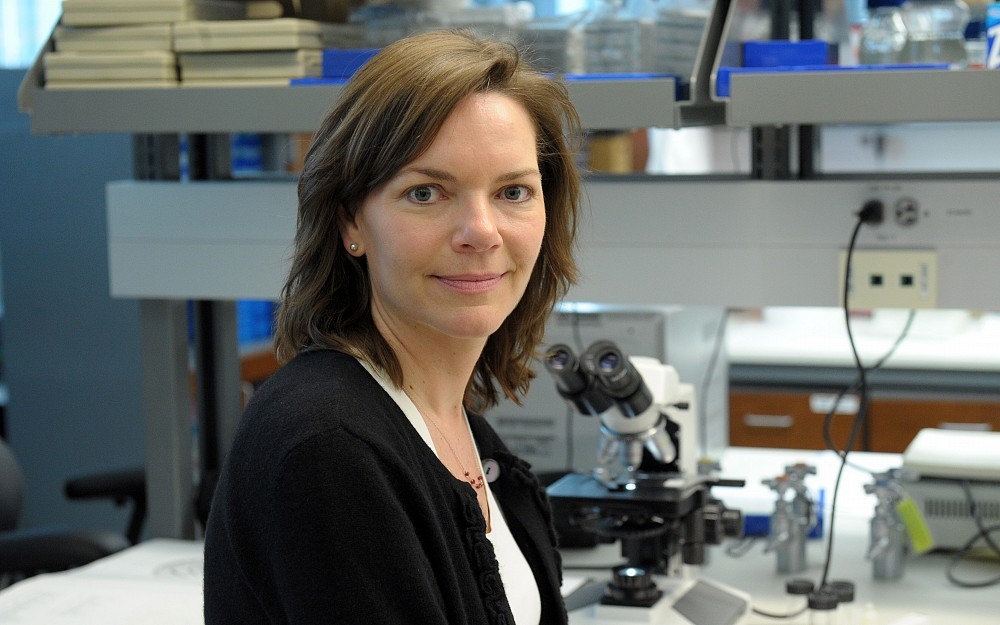
Focus on Research With Sheila Fleming, PhD

Sheila Fleming, PhD, joined the UC faculty in 2010 as an assistant professor with appointments in the departments of psychology and neurology and rehabilitation medicine. From her lab in the CARE/Crawley Building, she studies Parkinsons disease on behalf of the Gardner Center for Parkinsons Disease and Movement Disorders at the UC Neuroscience Institute, one of four centers of the UC College of Medicine and UC Health.
What brought you to UC?
I decided to come to Cincinnati because of the opportunity to establish my own laboratory and line of research. I was a researcher at UCLA prior to coming here, and while I had a lot of independence and loved the projects I was involved in, I felt I had to take advantage of the UC opportunity.
What is the focus of your research?
Parkinsons disease (PD), the second-most common neurodegenerative disorder (after Alzheimers disease), is characterized by the development of alpha-synuclein positive Lewy bodies, abnormal protein aggregation, in the brain and progressive neurodegeneration of midbrain dopamine neurons. Most people know PD as a disease that affects the motor system because at the time of diagnosis patients typically display a combination of motor impairments such as bradykinesia, rigidity, resting tremor, and postural instability. However, PD is really a systemic disease affecting multiple systems including gastrointestinal, autonomic, cognitive, emotional, and olfactory functions. Within the last 5 to 10 years these non-motor symptoms have received a lot of attention, primarily because there are reports that many of them may actually develop early in the disease, prior to the onset of the motor symptoms. This makes them ideal targets for early detection and the development of neuroprotective therapies. In addition, there is a link between the abnormal accumulation of the protein alpha-synuclein in Lewy bodies and the symptoms of PD.
In our lab we study this link between abnormal accumulation of alpha-synuclein and behavioral symptoms. We work with genetic mouse models of PD and have done the most research with mice that overexpress alpha-synuclein throughout the brain similar to an inherited form of PD. We have shown that these mice develop motor and non-motor impairments reminiscent of the deficits observed in PD including olfactory deficits, gastrointestinal dysfunction, cognitive impairments, and most recently cardiovascular autonomic dysfunction. Now we use these behavioral outcome measures when testing potential therapeutics. We believe that by testing the effect of a molecule on both motor and non-motor impairments this will lead to better translation for patients. While there are symptomatic treatments for some of the motor symptoms associated with PD, there are currently no disease-modifying therapies. That is clearly one of the biggest needs for the disorder.
We are also studying factors that may be involved in alpha-synuclein accumulation and toxicity. In particular, we are interested in the degradation of alpha-synuclein by the autophagic-lysosomal pathways. We received an NIH grant in collaboration with Gary Shull, PhD, in the department of molecular genetics, biochemistry and microbiology here at UC to study the interaction between alpha-synuclein and another protein called ATP13A2. The function of ATP13A2 is still unclear, but work in cell culture and yeast show it is associated with the lysosomal degradation of alpha-synuclein. We created a new model in order to study the interaction between alpha-synuclein and ATP13A2 in more depth. We are now collaborating with Ying Sun, PhD, of the department of pediatrics and Cincinnati Childrens Hospital Center, who is an expert in lysosomal degradation pathways. The hope is that we will be able to identify factors involved in alpha-synuclein accumulation and toxicity and then test different approaches to interfere and stop the toxicity from occurring.
One other project that we are working on and very excited about is our collaboration with Robert Krikorian, PhD, a clinician in the department of psychiatry and behavioral neuroscience. This is truly a translational project because his lab studies the effect of dietary interventions on cognitive function in people. Our lab is testing similar dietary interventions in our alpha-synuclein model to determine the effect of the diets on cognitive function and mitochondria and alpha-synuclein accumulation in the brain.
How will your discoveries impact patient care?
Since we test potential neuroprotective therapies in our models we could actually make a substantial impact on patient care by being part of the process of developing a new treatment for PD. That is our ultimate goalto contribute in some way to better therapies for patients.
What keeps you motivated to do your research?
It is actually many things. I would say what is very unique here at UC compared to the other places I have worked is the regular interaction the researchers have with the movement disorder clinicians and patients. This is incredibly motivating in many ways. Last year I presented some work our lab was doing on cognitive function in our models to a patient group, and afterward I was able to talk with the patients and really understand what symptoms are most problematic and how they can interfere with certain everyday tasks. This type of interaction can only make my research better.
Since we are scientists we get very excited when we make a prediction or formulate a hypothesis that actually happens as we predicted (somewhat rare), but we can be just as excited when we have a completely unexpected result (more common). I remember very clearly when I was back at UCLA and we were testing this compound that required us to perform daily intranasal injections for six months in our alpha-synuclein model. We were blind to drug condition and genotype so we analyzed all the behavior and brain data and we could see there were going to be some statistical differences but we did not know if the treatment was making the mice better or worse. I was working all day in a very dark room doing behavioral testing and came back to the lab at around 6 p.m. and my colleague was in the hall waiting for me to tell me that our PI had broken the code and the treatment worked! We both started jumping up and down and hugged each other. That kept us motivated for quite some time.
What do you like to do in your spare time?
My favorite spare time activities are cooking, traveling and reading.
Related Stories
UC radiation oncologist speaks with Local 12 news about clinical trial for head and neck cancer treatment
August 10, 2026

Dr. Sara Medek, a UC radiation oncology professor, speaks with Local 12 news about a new clinical trial aimed at reducing radiation in certain areas while still treating cancer effectively but with fewer painful side effects.
Cancer Center director charts future based on collaboration, AI
August 10, 2026

David Gius, MD, PhD, was featured in a Cincinnati Business Courier article and The Cancer Letter’s “The Directors" podcast discussing his priorities and goals as he recently took the helm as director of the University of Cincinnati Cancer Center.
UC graduates cross finish line at commencement
August 7, 2026
The University of Cincinnati recognized 2,125 graduates in two ceremonies at summer commencement Friday on campus at Fifth Third Arena.