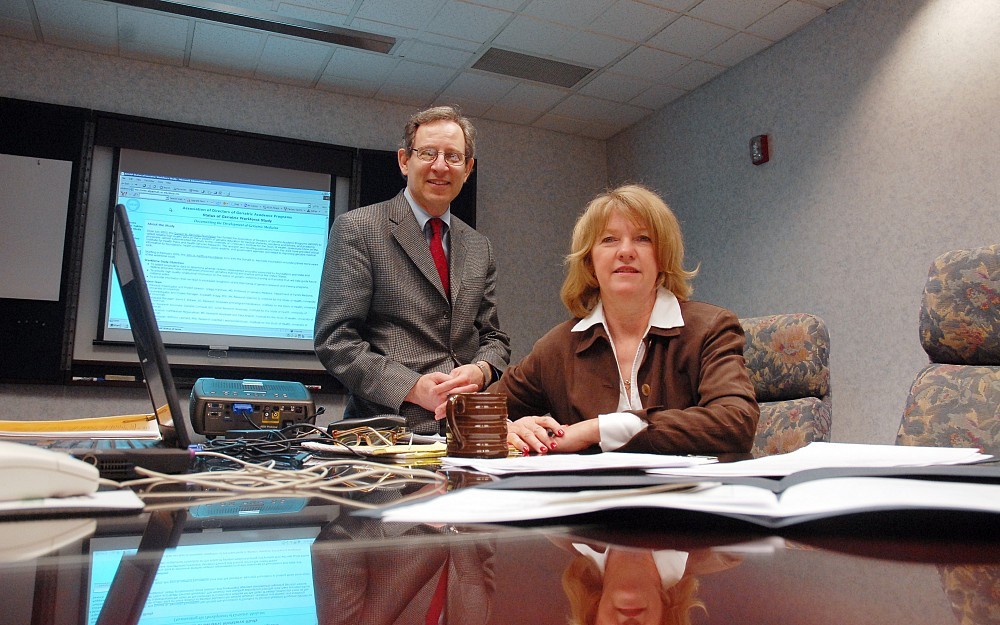
Changes Needed to Prepare Workforce to Care for Adults With Alzheimer's

Immediate and significant changes are needed in order to ensure a larger and better trained workforce able to care for the current and growing population of older adults with Alzheimers disease, say University of Cincinnati (UC) experts.
In a
manuscript published in the April 2014 issue of Health Affairs
, Gregg Warshaw, MD, of UCs College of Medicine, and Elizabeth Bragg, PhD, of UCs College of Nursing, outline a number of necessary policy actions for meeting the needs of the more than 5 million Alzheimers patients in the United States. That number is expected to triple by 2050, according to the Alzheimers Association.
Warshaw and Bragg suggest changes in health profession college curriculums, expanded team-based models of care and incentive programs to attract clinicians into education roles. In addition to care approaches and education strategies, they also recommend expansion of federal workforce training programs and increased compensation for the direct care workforce.
"The remarkable success of public health and medical care advances has led to many more Americans living into their eighties, nineties, and beyond, the authors say. "This accomplishment, unfortunately, has resulted in a growing number of adults who live with Alzheimers disease for a prolonged period.
"The care of adults with Alzheimers is particularly challenging and requires a large and well trained workforce.
Alzheimers disease is a disease of the brain characterized in its early stages by memory loss and progressing to marked memory loss and a decrease in thinking ability such as decision making and ability to perform activities of daily living.
Warshaw, the Martha Betty Semmons Professor of Geriatric Medicine and professor of family and community medicine at UC and director of the Geriatric Medicine Program, has already developed programs to integrate Alzheimers care early into medical student education. In 2011, he and a team launched a four-week longitudinal teaching module as part of the required third-year family medicine clerkship on the evaluation and management of the older adult patient and caregiver. The program uses standardized patients to put a focus on Alzheimers disease.
But, he and Bragg agree, more needs to be done.
"Without an immediate and significant commitment to developing the health care workforce to address this challenge, many older adults with dementia will receive inadequate care, the authors write. "By extension, their children and grandchildren will be burdened with extraordinarily challenging responsibilities for which they will not receive sufficient support.
In the United States, one in nine people ages 65 and older and one-third of people ages 85 and older have Alzheimers disease.
Related Stories
UC radiation oncologist speaks with Local 12 news about clinical trial for head and neck cancer treatment
August 10, 2026

Dr. Sara Medek, a UC radiation oncology professor, speaks with Local 12 news about a new clinical trial aimed at reducing radiation in certain areas while still treating cancer effectively but with fewer painful side effects.
Cancer Center director charts future based on collaboration, AI
August 10, 2026

David Gius, MD, PhD, was featured in a Cincinnati Business Courier article and The Cancer Letter’s “The Directors" podcast discussing his priorities and goals as he recently took the helm as director of the University of Cincinnati Cancer Center.
UC graduates cross finish line at commencement
August 7, 2026
The University of Cincinnati recognized 2,125 graduates in two ceremonies at summer commencement Friday on campus at Fifth Third Arena.