Team Science Yields Dividends for UC Researchers

Collaboration across disciplines by researchers may not be a new concept, but its at the core of an initiative known as "Team Science and promoted by the National Institutes of Health.
Team Sciences focus on interdisciplinary collaboration helps expose researchers to a broader range of ideas, knowledge and perspectives when working to develop scientific breakthroughs to cure disease. When it has been smartly applied, team science has yielded good results for the University of Cincinnati.
The proof is seen in the work of a team of researchers awarded a contract of $967,430 from the National Institutes of Health and the National Institute of Allergy and Infectious Diseases to evaluate the effects of experimental drugs in a mouse model of pneumocystis pneumonia.
The contract is in its third year of renewal and research and is titled, "Pneumocystis murina Small Animal Model Utilization for Therapeutic Evaluation.
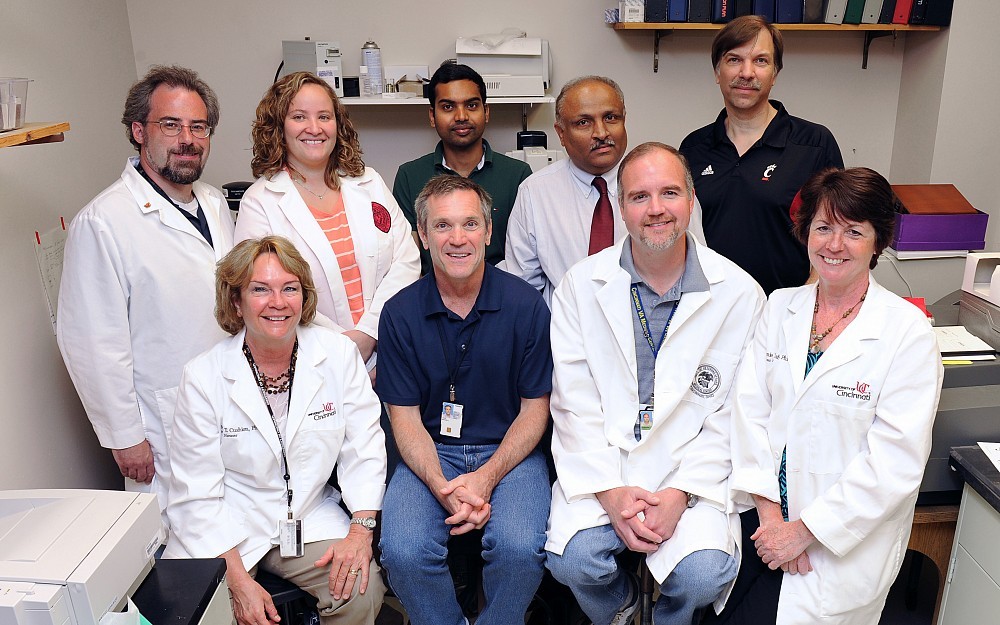
The researchers include: Melanie Cushion, PhD, professor in the division of infectious diseases; Michael Linke, PhD, a researcher with the Cincinnati Department of Veterans Affairs (VA) Medical Center; Pankaj Desai, PhD, professor of pharmacokinetics and drug metabolism at the UC James L. Winkle College of Pharmacy; and Larry Sallans, PhD, a researcher in the McMicken College of Arts and Sciences Department of Chemistry.
"We have chemists, pharmacists and infectious disease specialists along with graduate students and technicians who create a dynamic team, says Cushion, also senior associate dean for research in the College of Medicine. "We have all of our different areas of expertise and it comes together in way thats really synergistic.
The teams research will test new drugs designed to fight pneumocystis pneumonia, an infection of the lungs that can affect individuals living with HIV, undergoing cancer treatment, receiving an organ transplant and individuals with chronic obstructive pulmonary disease or those who receive immune-therapy for rheumatoid arthritis, explains Cushion.
Any population that is immuno-suppressed can be affected. Resistance to current treatment for pneumocystis pneumonia is a concern and is spurring the need for new drugs, says Cushion.
The incidence of pneumocystis pneumonia in HIV patients has dropped dramatically in the United States due to anti-retroviral therapy, though it continues to be a concern in some developing countries, explains Linke, also a volunteer associate professor in the Department of Internal Medicine. The major susceptible population to the opportunistic infection has been HIV patients.
"It still can be a problem here, but just not as prevalent in that population, says Linke. "We see it more and more in transplant patients, who receive treatment to reduce rejection of the organ. Their immune systems become debilitated by the anti-rejection therapies and they then become susceptible to infection with pneumocystis. Cancer patients are also getting treatment that reduces their immune response, so it is a problem in that population as well.
Cushion says the teams work is strengthened because of its partners in the Colleges of Pharmacy and Arts and Sciences. Pharmacokinetics is the study of what the body does to a drug and is also an important component of the research and is led by Pankaj Desai. Such studies provide an assessment of the absorption, distribution, metabolism and excretion of drugs and investigational agents, which is critical for determining the most appropriate dosing regimen (dose, route of administration and dosing frequency) to ensure maximal efficacy and minimal toxicity.
Researcher Larry Sallans says his lab accepts samples of blood and tissues used in the mouse models and uses a mass spectrometer to provide information about the concentration of experimental drugs in blood which facilitates determining the time course of the drug and metabolites and derive important pharmacokinetic parameters.
How a drug is administered does impact its bioavailability or the amount that is absorbed into the body and reaches the site of physiological activity, says Sallans. A drug given intravenously typically has a much higher bioavailability level than the same drug given orally and may also interact differently with the body.
Related Stories
UC expert offers advice to Cincinnati on climate change
August 14, 2026

In an op-ed, UC Associate Professor Bob Hyland talks about ways Cincinnati can become more resilient in face of climate change.
Ancient warming event hints at potential climate tipping point
August 12, 2026

Researchers say a spike in temperatures during an ice age 304 million years ago could inform what climate scientists are learning about rapidly changing conditions today.
Career fairs and resources for every Bearcat
August 11, 2026
UC's fall career fairs connect Bearcats with co-ops, internships, and jobs — plus free resume help, career coaching, and prep resources at the Bearcat Promise Career Studio.