Lung Cancer Screening Program Partners With Batesville Hospital

CINCINNATIThe University of Cincinnati (UC) Cancer Institutes Lung Cancer Program is partnering with Margaret Mary Health (MMH), a community hospital in Batesville, Indiana, to further help residents in the Tristate region identify lung cancer in its earliest, most curable stages.
Lung cancer is the leading cause of cancer death in the U.S., yet if detected early, it has cure rates as high as 90 percent.
"The experts at UC are helping us offer this much-needed program to our community, said Liz Leising, MMHs chief nursing officer. "We are proud of the compassionate care and top-notch treatment we are able to provide at our cancer center, but we also understand the importance of collaborating with larger health systems when more specialized care is needed.
The UC Cancer Institutes Lung Cancer Screening Program was the first program of its kind in the region and has been designated a Screening Center of Excellence by the Lung Cancer Alliance.
As part of this partnership, lung cancer experts at MMH screen local patients using the protocol that has been created and used since the UC Cancer Institutes Lung Cancer Screening Programs beginning in 2012the UC program is celebrating its fifth anniversary. Physicians at MMH send more complex cases to the team at the UC Cancer Institute for treatment; then, patients are sent home for follow-up care from experts at MMH. The partnership also expands patients access to clinical trials only offered at a larger academic center.
In 2011, the National Cancer Institute published data supporting chest CT scans as an effective lung cancer screening tool for a high-risk patient population. The study showed that when current or former heavy smokers were screened with low-radiation dose CT scans versus traditional chest X-rays, there was a 20 percent reduction in lung cancer-related deaths. A separate UC-based trial evaluating chest CT scans in a population of 132 heavy smokers also supported the imaging technique as a viable screening tool in a high-risk population.
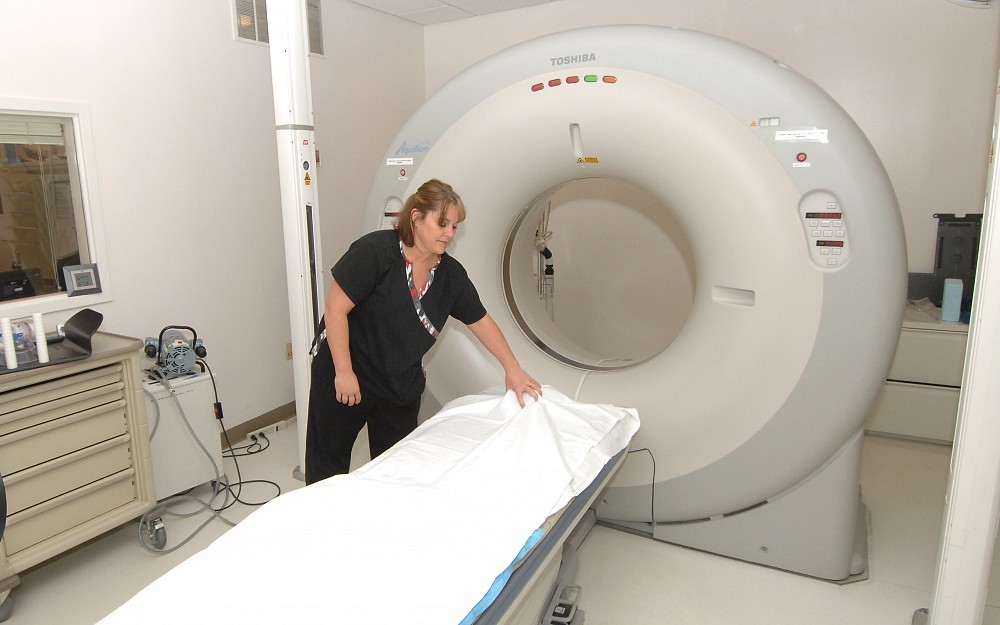
Traditional chest X-ray produces a flat, two-dimensional picture. With low-dose CT scanning, which are used in lung cancer screening, the X-ray tube is rotated around the patient during the imaging test to create a 3-D picture of the chest which can detect very small spots.
"This allows lung cancer specialists to view the lungs one slice at a time. Spots that are too small to show up on a chest X-ray are more likely to be detected and specialists can intervene early on concerning lesions, says Sandra Starnes, MD, director of thoracic surgery at the UC College of Medicine, UC Health thoracic surgeon and co-director of the UC Cancer Institutes Lung Cancer Center. "This collaboration is so important in furthering preventive care. We are very excited to be working alongside the experts at MMH to help detect these cancers and treat them earlier for better patient outcomes.
Lung cancer doesnt commonly cause symptoms until the cancer is more advanced, and lung cancer screenings are critically important to help identify cancer early when its easier to treat, she adds.
To be eligible for the screening, participants must be between 55 and 80 years old and have smoked at least one pack of cigarettes per day for 30 years or two packs per day for 15 years.
For more information, call 513-584-LUNG (5864).
Related Stories
UC radiation oncologist speaks with Local 12 news about clinical trial for head and neck cancer treatment
August 10, 2026

Dr. Sara Medek, a UC radiation oncology professor, speaks with Local 12 news about a new clinical trial aimed at reducing radiation in certain areas while still treating cancer effectively but with fewer painful side effects.
Cancer Center director charts future based on collaboration, AI
August 10, 2026

David Gius, MD, PhD, was featured in a Cincinnati Business Courier article and The Cancer Letter’s “The Directors" podcast discussing his priorities and goals as he recently took the helm as director of the University of Cincinnati Cancer Center.
UC graduates cross finish line at commencement
August 7, 2026
The University of Cincinnati recognized 2,125 graduates in two ceremonies at summer commencement Friday on campus at Fifth Third Arena.