UC’s engineering community donates protective equipment to UC Health
PPE donations came from labs, student groups and individuals

University of Cincinnati’s College of Engineering and Applied Science collected unused personal protective equipment and other supplies from its labs and student groups and donated them to UC Health.
With most UC labs temporarily closed and student activities canceled amidst the COVID-19 pandemic, various labs and student groups including AeroCats, Rocket Club, Concrete Canoe and Hyperloop, responded to the need for protective gear.

Masks, gloves and other gear were collected from CEAS labs and delivered to UC Health. Photo/Provided.
Laura Pinelo, safety specialist II, and Curt Fox, a senior research associate, coordinated the collection from labs and offices in college buildings. Individuals and groups reported what they had available to donate and where it was located on campus and a few designated people went around to collect the items, Pinelo said. Pinelo and David Warmack, the college's building services coordinator, delivered the donations to UC Health on April 17.
“As a college, we are contributing to the solutions of this wicked problem in many ways and this was one more opportunity,” said Teri Reed, assistant vice president for research development.
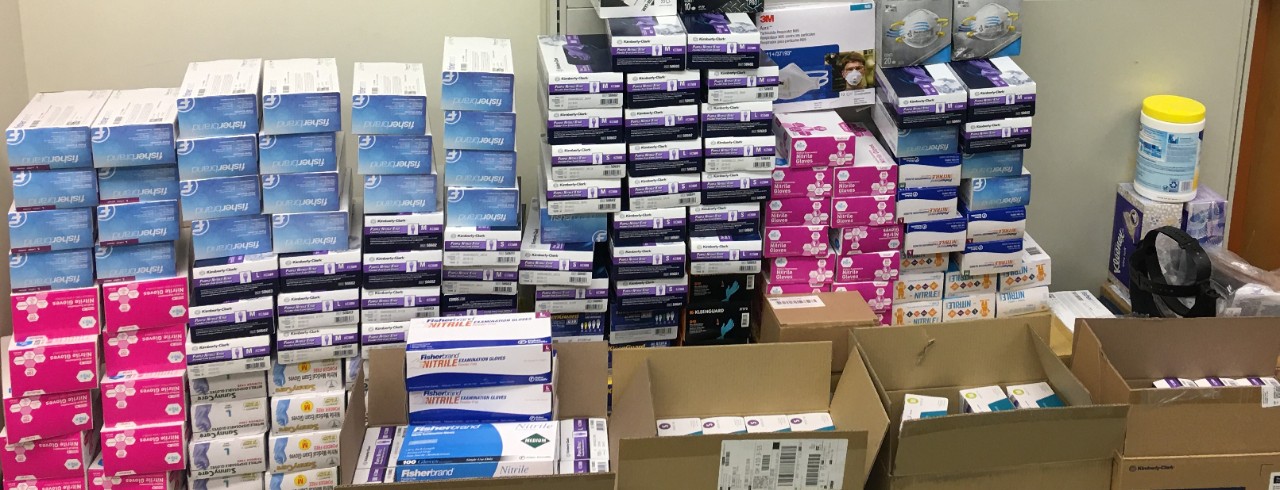
The college collected 195 N95 masks, 190 boxes of gloves and 123 pairs of safety glasses and goggles, plus face shields, shoe covers, cleaning supplies and swabs that might be suitable for testing.
Other colleges throughout the university also collected items for medical facilities, including the College of Arts and Sciences, which also has many labs sitting idle during this time.
“It was wonderful to see how quickly the colleges came together to help our healthcare workers. We are inspired by the work and sacrifices our colleagues are making in caring for those infected by the coronavirus, and it’s nice to know we can do our small part,” Dean John Weidner said.

Junqiu Wang, assistant professor in engineering, personally purchased 6,000 masks for healthcare workers. His young daughter helped him organize the boxes. Photo/Provided.
UC faculty also contributed. In mid-March, Junqiu Wang, assistant professor in the Department of Engineering Education and the Joint Co-op Institute, heard from a friend who asked if he needed any masks for personal use. Having learned about a lack of PPE for healthcare workers on the news, Wang asked his friend to connect with his contact in China to send as many masks as he could acquire. Wang personally purchased 6,000 surgical masks that were delivered to his home.
“I contacted UC Health and asked about the possible needs and they told me any PPE would be welcomed. I donated about 5,000 surgical masks to UC Health. I gave a friend of mine who works at Premier Health about 1,000,” Wang said. “My motivation is very simple: I need to help out during this epidemic.”
Visit UC Health to learn how you can help support local medical professionals.
Featured image at top: PPE and other items were gathered from labs and offices across the College of Engineering and Applied Science. Photo/Provided.
Read more stories on the CEAS response to COVID-19
- UC recognizes COVID-19 work with video
- UC engineering student helps raise $170K for COVID-19 relief
- UC grad's company offers new COVID-19 test
- UC student creates COVID-19 field hospital in convention hall
- UC engineering student's co-op job shifts to making face masks
- Construction student group donates canned goods to Bearcats Pantry after project canceled due to COVID-19
Related Stories
President Pinto’s 2nd glow party brings first-year Bearcats together
September 20, 2026
UC President Neville Pinto and team hosted the second annual Bright Beginnings glow party for first-year students
How phone scammers use your own voice against you
September 18, 2026

The Wall Street Journal recently did a deep dive on how artificial intelligence is making scamming people over the phone much easier, citing research by Kimberly Hyun, assistant professor of marketing at UC’s Lindner College of Business.
UC emergency medicine physicians safely eliminate thousands of unnecessary CT scans
September 18, 2026
A University of Cincinnati emergency medicine quality improvement campaign avoids 3,500-plus head and cervical spine CT scans, saving $6.2 million in patient charges, more than 14,000 hours of waiting time and significant radiation exposure with no patient harm.