Shedding Light
on invisible disabilities
Students, faculty and staff benefit from UC’s mental health resources and accommodations

UC alum Mark Simon recites his diagnoses with ease, much the same as he would state his name and address: “I live successfully with bipolar disorder, OCD and ADD.”
Simon’s candor about having mental health challenges is part of his persona. It’s this open attitude, he says, that has carried him through a prestigious postgraduate business career and into his current role as the founder of Mark Simon Says, a mental health speaking and consulting business.
“I’ve been very successful, and I owe it to the skills I gained at UC,” he says of reaching out to UC’s Accessibility Resources as an undergraduate, after struggling with his grades due to mental health complications and a hospitalization.
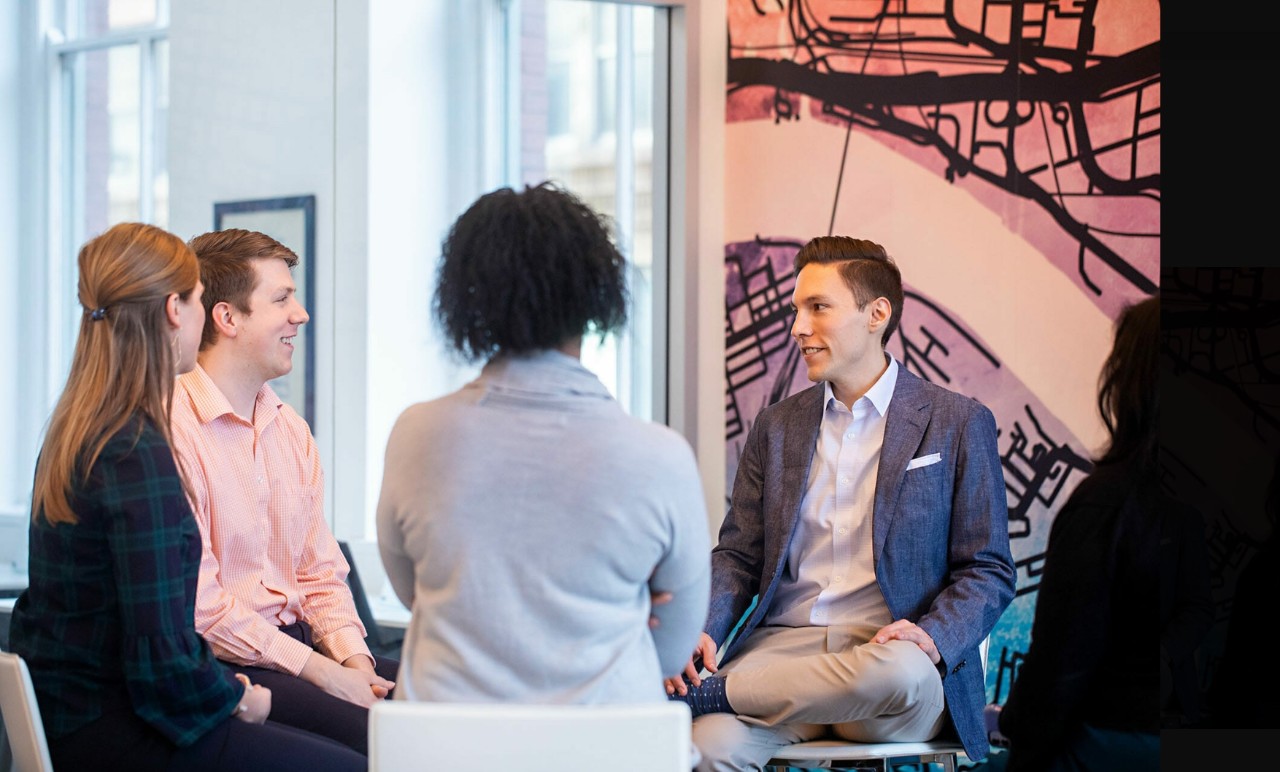
UC alum Mark Simon (right) advocates bringing mental health issues into the light through a consulting business he started after a successful career as an accountant. Photo/provided
The skill set he developed while at UC, such as organization and time management and communicating his disabilities to professors and peers, he says, “are coming to play now that I’m a student again.”
“UC did a good job of helping me learn how to set up a support network,” says Simon, who graduated with honors with a bachelor’s degree in business administration in 2012 and went on to work as a corporate accountant at top tier firms. During the pandemic, however, he decided to change careers. He went to work in the mental health field and started his consulting business. He is currently working toward a master’s degree in public health at The University of North Carolina at Chapel Hill.
— Mark Simon | UC alum ('12) and mental health advocate
“We work to ensure that each person’s needs are considered and ultimately met with the goal being for students to ‘just to get to go to class,’” says Matt Sauer, who was Simon’s accommodation coordinator while on the Uptown Campus and is now the assistant director of accessibility services at UC Clermont.
“Everything was facilitated through Matt. He went above and beyond in helping me communicate with professors in addition to helping me get the proper health care,” says Simon.
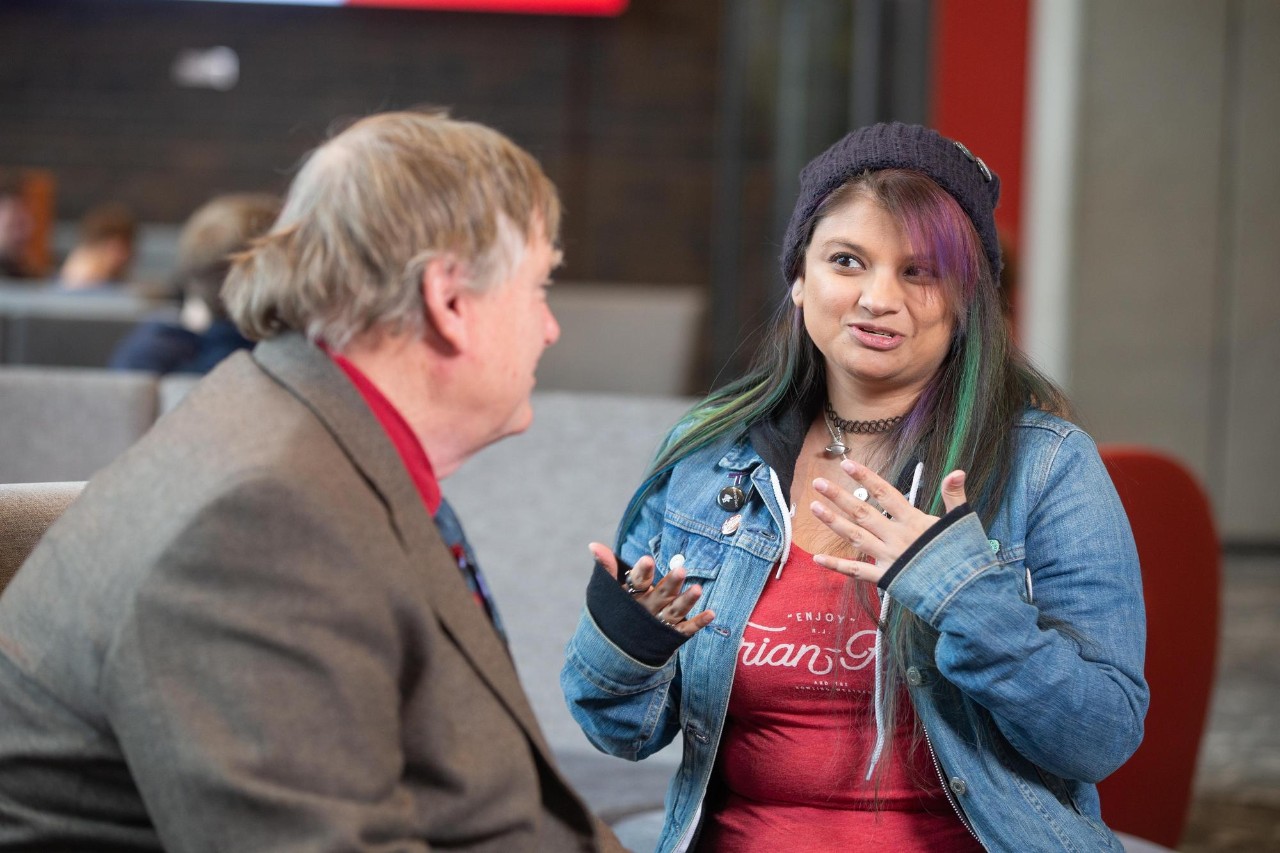
Matt Sauer, accessibility director at UC's Clermont campus, talks with Kristen Adriana, a second-year social work major. Sauer helps Adriana navigate the coursework required to meet her career goals while also struggling with mental health issues. Photo/Andrew Higley/UC Marketing + Brand
Inclusion means access for all
As of fall 2022, approximately 2,600 UC students from across all campuses were enrolled in accessibility services. While their disabilities include physical disabilities such as mobility, chronic illness, blindness/low vision or deaf and hard of hearing, the majority of those enrolled in the service (approximately 2,000 students) have mental health diagnoses such as anxiety, obsessive compulsive disorder (OCD) or neurodivergent identities such as autism and attention deficit disorder (ADD).
“UC has worked diligently to build a reputation for access,” says Heidi Pettyjohn, executive director of accessibility. Accommodations, she says, can include, but are not limited to extended testing time, a quiet testing room, materials provided in alternative format (i.e., e-textbooks, digital copies of notes, peer’s notes, a reader for exams, a scribe), sign language interpreting, open or closed captioning of classroom videos and assistive technology.
Conversation, says Michael Southern, director of accessibility services on the Uptown Campus, is key to determining accommodation: “For example, a neurodiverse student with an ADD diagnosis may need additional time in a distraction reduced environment to complete an exam so they can focus on the questions while a student with a mental health diagnosis, such as depression, may need advocacy and support when their disability manifests and attending class becomes difficult.”
— Kristen Adriana | Second-year social work major
“People forget that there are invisible disabilities. No one would know by looking at me that I have severe anxiety and a math learning disability,” says Kristen Adriana, a second-year social work major on UC’s uptown campus.
Adriana, from Dayton, Ohio, started her studies on the Clermont Campus, where Sauer also facilitated her accommodations, such as finding a math tutor to assist with a required statistics course and providing recording software to keep up with class notes.
Ways to address mental health at UC
- Quiet your mind at the UC Student Wellness Center
- Subscribe to the Calm App. Free to faculty, students and staff
- Sign up for yoga classes at the Campus Recreation Center
- Tap into Accessibility Resources for accommodations
Spaces and tools that complement well-being
“When you match the student with the right professor or mentor and tools then the student will want to succeed,” adds Sauer who is currently overseeing the development of a sensory reset room at Clermont College. The room offers tactile, visual and kinetic experiences and a large touchscreen monitor to interact with visual mediums. Spaces such as this, he says, are particularly useful to those with mental health challenges that can be mitigated by the person withdrawing for a moment to “reset”. The space allows them to control their sensory inputs in a way that encourages greater self-control and self-care, he says.
This creation of a purposeful wellness space for students is similar to the recently celebrated expansion of a new Student Wellness Center on the Uptown Campus. The multi-level space offers free health products, games and activities, event space and quiet reflection space. Trained student peer educators provide education and help visitors find appropriate resources.
Students, faculty and staff can also find peace of mind in the palm of their hands. As of Oct. 2022, UC provided students and employees access to a one-year premium subscription to Calm, a digital health app that includes a mood check-in, breathing techniques, a daily Calm reflection, a sleep tracker, resources for guided movement and soothing soundscapes.
Full and equal access in education
Accessibility resources also serve as a faculty and staff resource for education and training on how to accommodate students with disabilities. UC, in spring 2021, launched the first program to offer students a certificate in disability studies. The creation of the certificate program was inspired in part by the experiences of students, says Cheli Reutter, an associate professor of medical humanities who helped develop and directs the program.
A key intent of the program is to cultivate understanding of ableism, or the cultural perception that people with disabilities are deficient versus different, and through that examine policies and implicit biases that enable discrimination in favor of able-bodied people.
— Cheli Reutter | Associate professor of medical humanities
Given the mindset that disability is an individual tragedy — something to be pitied or remediated — people tend to resist or deny the fact that ableism exists.
“UC is becoming a place where we can embrace disabled identity — or we can talk about our disabilities as part of our identity,” says Reutter. The culture is starting to transform, she says, through the efforts of Accessibility Resources advocates, the Disabled Faculty and Staff Association, classes and the new disability studies certificate and, significantly, through students.
Just because you have an able body, your mind can still have struggles, says Adriana. “Students may not think that they need the accessibilities department, but it’s for everyone.”
Living with a disability or disabilities, Sauer adds: “Is a factor of human living and students need to have all access to the university experience.”
All photos/UC Marketing + Brand
Digital design/Kerry Overstake/UC Digital + User Experience
Become a Bearcat
Whether you’re a first-generation student or from a family of Bearcats, UC is proud to support you at every step along your journey. We want to make sure you succeed — and feel right at home.
Related Stories
UC Biomedical Engineering student launches mobile healthcare platform
October 22, 2026
As a fifth-year biomedical engineering student at the University of Cincinnati College of Engineering and Applied Science, Amelia Wares has been a trailblazer in nearly every area imaginable — and this is only the beginning of her journey.
Still the top ‘cat
October 20, 2026

The University of Cincinnati Bearcat mascot was voted Cincinnati’s favorite mascot in a Cincinnati Enquirer reader poll, earning 45.1% of the vote and topping other local favorites.
Researchers test gene therapy as less invasive treatment for hydrocephalus
October 20, 2026

Researchers at the University of Cincinnati College of Medicine say an experimental gene therapy could eventually lead to a less invasive treatment for hydrocephalus, a condition in which excess fluid accumulates in the brain. The early-stage study, led by Agnes (Yu) Luo, PhD, professor and vice chair for research, was published in the journal Fluids and Barriers of the CNS. Yahoo! News recently featured it.
Ultra-processed food intake may increase dementia, stroke risk
October 20, 2026

The University of Cincinnati's Suzanne Judd, PhD, commented to Healthline on a new study that found healthy adults who eat high levels of ultra-processed foods may be more likely to show signs of damage to the brain that could increase the likelihood of stroke and future memory problems.
UC’s concrete icon remembered
October 20, 2026
Crosley Tower is gone, but the stories remain: UC’s concrete legend, by the numbers and in your words.
CCM Media Production students take 'The Rotation' live at Big 12 Media Days
October 20, 2026
Media Production students from the UC College-Conservatory of Music will help produce and broadcast "The Rotation" live, bringing the Big 12 original to Basketball Media Days on Oct. 20-21 in Kansas City. Watch their work on episode 2 of “The Rotation,” airing live on the Big 12’s YouTube channel each day from 2-4 p.m. CT, with interviews and short-form content available across Big 12’s social media platforms.