
UC students engineer robotics safety and strategy
Capstones, co-ops & code delivered at UC 1819 Innovation Hub

At the University of Cincinnati, experiential learning isn’t just an add-on; it’s the foundation.
Home to the nation’s first and oldest cooperative education program, UC has climbed to the fourth-ranked spot among U.S. News & World Report’s 2026 Best Colleges for Co-ops and Internships. And for good reason: UC has built a reputation for graduating students who aren’t just job-ready but impact-ready. That promise comes to life every day at the 1819 Innovation Hub, where co-op and capstone students work shoulder to shoulder with startups, researchers and industry partners solving problems in real time.
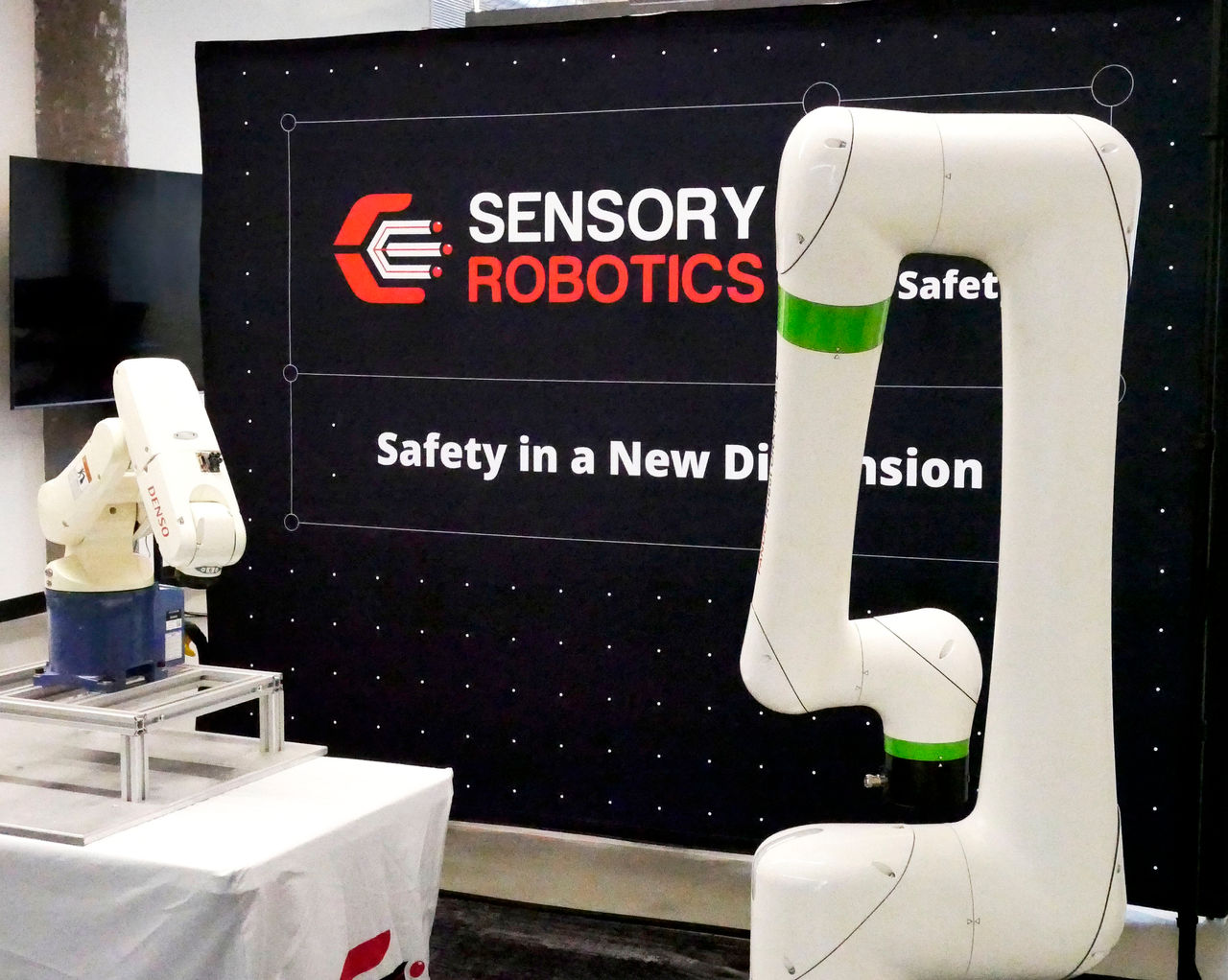
Demo robotics inside Sensory Robotics. Photo/Greg Glevicky
For UC students Jacob Scott, Aymaan Khan and Daksh Choksi, that meant working with 1819 corporate partner Sensory Robotics, a fast-growing robotics safety startup redefining how humans and machines work together.
Co-founded by CEO Chris Edwards and Tristan Fogt, the firm’s chief technology officer, Sensory Robotics is the only system capable of ensuring the safety of mobile and arm-integrated robots. The company’s product enables humans and heavy robots to work safely and efficiently side by side. Sensory Robotics’ flagship product, SR-1, uses real-time 3D imaging to scan environments, detect hazards and create a safety zone that replaces outdated, restrictive tech.
Mark Gagas, chief operating officer of Sensory Robotics, says the company's decision to move to 1819 reflects its commitment not only to scaling but also to tapping into UC’s engineering, information technology, marketing and industrial design talent.
A capstone with real impact

Slide from presentation deck of Jacob Scott, MS Marketing. Photo/Jacob Scott
Jacob Scott, a graduate student at UC’s Carl H. Lindner College of Business, completed his master’s capstone in marketing this December by working with Sensory Robotics on a real-world project with firm deadlines and immediate impact.
“My goal was to solve how Sensory Robotics’ SR-1 could gain credibility and reduce barriers to adoption in a conservative market,” Scott says.
Graduating this past fall, Scott saw his capstone as the culmination of a carefully planned transition from journalism to marketing. What he didn’t expect was how deeply embedded he would become in the traditional, highly regulated robotics safety industry.
“Sensory is trying to break into a space dominated by decades-old 2D safety systems,” Scott notes. “My job was to help them figure out how to talk about something truly new in a market that doesn’t embrace change that easily.” He shares that it felt like a rare opportunity to work with a company “that is actually trying to change something.”
Working out of 1819, Scott interviewed industry experts, studied certification pathways and developed a messaging framework that Sensory Robotics can carry forward. “1819 is such a cool place,” Scott says. “It’s hard to explain, but when you’re in that space, you can just tell that great people are working on great ideas.”
Being surrounded by startups, researchers and global corporate partners made everything Scott worked on feel more “real” and less like a class assignment. “It gives you a front-row seat to how innovation actually happens, not just how it’s described in a textbook.”
A breakthrough moment occurred during a conversation with his wife on the way to pick up their four-month-old son. Scott landed on the phrase “compatible today, foundational tomorrow,” which became his framework for Sensory Robotics’ SR-1 positioning.
What made the entire experience stand out was autonomy. Scott says he was treated less like a student and more like a consultant. His advice to future capstone and co-op students: “Be ready to dive in. You’ll probably feel overwhelmed at first, but that’s normal. Ask questions and don’t be afraid to explore the messy parts.”
Scott describes startups as fast-moving with an expectation of adaptability, which can be intimidating but also rewarding.
“You have to make decisions, abandon ideas that don’t work and build something useful under real constraints,” he says. “That kind of learning just doesn’t happen in a lecture hall.”
Engineering at full throttle

UC co-op, Aymaan Khan. Photo/Aymaan Khan.
When Aymaan Khan and Daksh Choksi, both computer science majors attending UC’s College of Engineering and Applied Science, completed their Sensory Robotics co-ops together in December, the experience had already exceeded expectations of what undergrads can achieve and contribute.
Khan is energized by tackling complex problems with no single right answer and endless paths to a solution. “The only limitation in engineering,” he says, “is your own creativity.”
What interested Khan most about Sensory Robotics’ co-op was its pioneering work in automation and robotics safety. He says, “I was also really excited to work with domain experts like Tristan, Chris and Mark, who bring outstanding achievements across their respective fields.”
As a sophomore graduating in 2029, Khan thought he’d start in training mode, onboarding slowly. Instead, he was immediately trusted with complex technical challenges, including integrating advanced depth-sensing cameras. Khan completed the integration in three weeks; it was his first real test at Sensory, and it set the tone for everything that followed.
Using Python and C++ to build and control robotics and AI systems while utilizing Blender to create models of complex environments, Khan helped dramatically improve the robots’ field of view and depth perception.
Sharing how he used matrices, advanced linear algebra and spatial mathematics to construct accurate point cloud systems, Khan says, “The accurate visual representation and generation of mathematically sound point cloud systems was by far the most challenging … The challenge required validating 3D spatial accuracy under varying sensor geometries, a problem demanding precise mathematics to ensure both performance and safety in real-world deployments."
Khan explains that it’s essential for others to understand what Sensory Robotics is building. “Before this experience, our solutions were difficult for nontechnical stakeholders to grasp.” Recognizing that stakeholder understanding is critical to product adoption, Khan translated complex technical systems into accessible concepts for customers and future clients. “To be able to interpret and deliver exactly that,” he says, “has been an incredible learning experience.”
Beyond robotics development, Khan learned about technical documentation. He spent time creating comprehensive guides for Sensory's intricate systems that future engineers and clients could understand. “I realized that clear documentation isn't just a nice-to-have,” Khan says. “It's as critical to the product as the code itself.”
“Powerful” is the word Khan uses to describe his co-op experience with Sensory Robotics. “Working at the 1819 Innovation Hub, I got to meet so many influential, smart and innovative industry leaders … As a result, my LinkedIn connections have now skyrocketed.”
Building for the future

Daksh Choksi, co-op student. Photo/Aymaan Khan
Choksi's work went just as deep.
Set to graduate in 2029, he’s long been fascinated by how software can solve complex, real-world problems. After researching Sensory Robotics, Choksi became excited about the way it advances robotics safety using sophisticated software systems. “The idea of contributing to technology that helps people interact with robots more safely and effectively was something I found extremely motivating,” he says.
Before starting, Choksi thought he’d be given simple assignments with little impact on the overall system. “Instead, I was entrusted with significant responsibilities like refactoring their entire graphical user interface,” he says. Choksi’s experience greatly exceeded his expectations and demonstrated that co-op students can play important roles when they’re willing to learn, communicate and take ownership of their work.
Working alongside Khan, he developed efficient integration for users to configure and interact with safety-critical robotics systems. “The new interface improves and solves the problem of complexity by giving users a straightforward way to adjust settings and visualize data,” he says. “It also supports new features that improve workflows and help users interact with the system more confidently.”
Choksi worked with programming tools React, Python and Go to build user interfaces that power backend systems and manage supporting applications. He also used C++ to tackle a massive codebase and added new functionality to support future product expansion. This type of work is typically reserved for full-time engineers.
A well-designed interface is an exceptionally important safety feature. Choksi mentions that if users can’t clearly see what the system does, it’s a safety risk.
The most significant challenges he faced were adding drag-based movement to components and learning the entire codebase from scratch, both of which required patience, creativity and careful attention to detail.
Choksi’s co-op experience confirmed that he wants to pursue highly technical work in robotics, AI or complex software systems.
“I learned how to work with a large, complex codebase, which is something classrooms usually cannot replicate,” Choksi notes. “I also learned how to solve problems that do not have a clear answer and how to adapt as new issues appear.”
Both Khan and Choksi describe a defining moment when they presented a deep dive into the system for Sensory Robotics’ leadership and safety advisers.
“They asked if they could use our presentation in the future with clients,” Khan says. “That’s when it hit us; we weren’t just interns. We were contributing to something bigger than ourselves.”
“These students raised the bar. Their creativity, technical skill and dedication proved that when UC students are given complex challenges and responsibility, they can drive tangible impact.”
Mark Gagas, Chief Operating Officer, Sensory Robotics
Work-ready by design

Chris Edwards (left) and Mark Gagas discuss robotics safety. Photo/Greg Glevicky
What’s happening at the 1819 Innovation Hub shows why that legacy endures. By embedding students in real companies, especially emerging tech startups like Sensory Robotics, UC ensures that graduates don’t just understand theory but can apply it under pressure.
“Having Jacob, Aymaan, and Daksh on our team made a remarkable difference,” Gagas says. “Their contributions went far beyond typical student projects. They helped us move faster with deliverables we’ll use with customers and partners.
“These students raised the bar. Their creativity, technical skill and dedication proved that when UC students are given complex challenges and responsibility, they can drive tangible impact.”
Impressed by the results, Gagas is once again turning to UC’s co-op program to hire other mechanical engineering students for future semesters.
For Scott, Choksi and Khan, Sensory Robotics wasn’t just a line on a resume. It was proof that when Bearcats are trusted with real responsibility, they rise to meet it.
At UC, experiential learning isn’t preparation for the future. It is the future, and it’s happening now.
Featured image at top: From left, Mark Gagas, Chris Edwards, Daksh Choksi and Aymaan Khan. Photo/Aymaan Khan
Innovation Lives Here
The University of Cincinnati is leading public urban universities into a new era of innovation and impact. Our faculty, staff and students are saving lives, changing outcomes and bending the future in our city's direction. Next Lives Here.
Related Stories
DAAP students turn design skills into robotic solutions
August 26, 2026
Ten University of Cincinnati students joined 1819 Innovation Hub partner Sensory Robotics to test their design skills as part of the school’s Experiential Explorations Program
How two UC co-ops joined Procter & Gamble for fast-track innovation
September 2, 2026
University of Cincinnati cooperative learning students observed a real-world creative workshop with Procter & Gamble on an early-stage product.
Why Ohio is built to lead the AI economy
June 3, 2026
Ohio’s skilled workforce, long industrial legacy, low cost of doing business and focus on future technologies position it to lead the U.S. in an automation-driven economy.